AI training: learning when it really suits you
Training is important. At the same time, it is often difficult to organize in day-to-day business. Dates have to be coordinated, employees are not always available at the same time, content is understood at different speeds, and follow-up questions often only arise later in the work process.
With AI-supported training, continuing education becomes much more flexible, individualized, and effective.
Vimmera AI can prepare training content so that employees can access it at any time: in the office, working from home, on the go, or exactly when there is time for it. The training no longer has to take place at a fixed appointment. It is ready when it is needed.
This creates a new form of knowledge transfer: personal, interactive, verifiable, and tailored to the respective level of knowledge.
This is how training works today
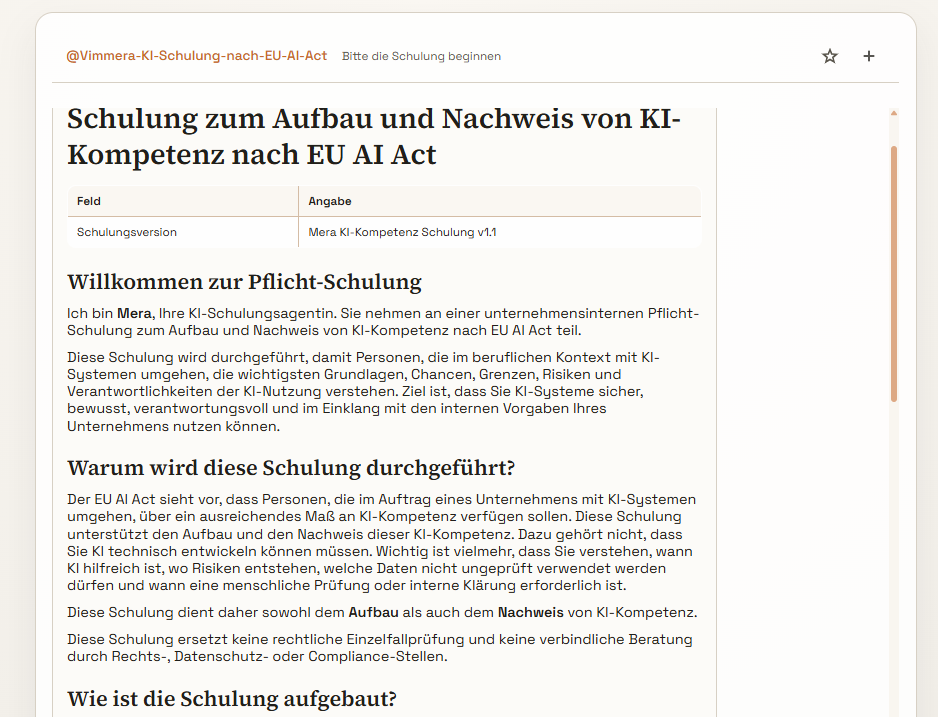
An AI training session is more than a video, a PDF, or a simple knowledge base.
The AI actively guides employees through a topic, explains content in an understandable way, answers follow-up questions, and adapts the depth of the explanation to the respective person. Anyone who needs a quick overview gets a clear summary. Anyone who wants to go deeper can ask follow-up questions, request examples, or have individual specialist topics explained step by step.
This creates an individual one-to-one training session that is not based on a rigid sequence, but on the actual learning need.
Interruptions are no problem. The training can be paused and continued later. Content can be explained again, rephrased, or illustrated using concrete company examples.
Everyone learns differently. The AI takes that into account.
Not all employees bring the same prior knowledge. Some need a simple introduction, others want to go deeper into the subject. Some learn better through examples, others through clear rules, checklists, or short repetitions.
An AI-supported training session can respond to exactly that.
The AI recognizes in the conversation which topics have already been understood, where uncertainties remain, and which style of explanation works particularly well. From this, it can adapt the further course: simpler, more detailed, slower, more direct, or with more examples.
This turns a standard training session into an individual learning experience.
Especially for complex topics such as data protection, IT security, product training, process knowledge, compliance, AI usage, occupational safety, onboarding, or internal policies, this can make a big difference.
Interactive questions instead of passive training
Traditional training is often one-sided. Content is presented, but follow-up questions either do not come up at all, come too late, or are asked only by a few people.
In an AI training session, every employee can ask questions at any time.
For example:
“Explain that to me more simply.”
“What does that mean concretely for my work?”
“Give me an example from our company.”
“What mistakes should I avoid?”
“Test me to see whether I understood it.”
“Summarize the most important points for me again.”
The AI remains patient, structured, and available. Even questions that someone might not ask in a group training session can be clarified directly.
This increases understanding and lowers the barrier to really engaging with a topic.
Quizzes, knowledge tests, and certificates
Training does not end with the transfer of information. What matters is whether the knowledge was understood.
That is why AI training can be combined with quizzes and tests. The AI asks comprehension questions, checks answers, explains mistakes, and can provide targeted follow-up training where uncertainties still exist.
Depending on the need, various forms are possible:
| Function | Benefit |
|---|---|
| Comprehension questions during training | Content is reinforced directly |
| Final test | Proof that the essential content has been understood |
| Review questions | Knowledge remains present for longer |
| Role-based questions | Employees are trained according to their job |
| Automatic evaluation | Results can be documented in a structured way |
| Certificate creation | Participation and learning success can be confirmed |
After successful completion, a certificate can be created automatically. This can, for example, include the name, training topic, date, achieved results, and validity period.
This creates not only better training, but also traceable documentation.
Automatically monitor training dates and deadlines
Many training sessions have to be repeated regularly. In practice, that is often time-consuming: Who needs to be trained when? Which training has expired? Who has not yet participated? Which proof is missing?
AI can help here too.
Training obligations, due dates, and repetition intervals can be monitored. Employees can be automatically reminded when a training is due or has not yet been completed. If desired, responsible persons receive overviews of open, completed, or soon-due training sessions.
This reduces manual administrative effort and creates more security in the training process.
Typical areas of use
AI-supported training is particularly suitable for topics where knowledge must be conveyed, updated, or verified regularly.
Examples:
| Area | Possible training content |
|---|---|
| Onboarding | Introduction to the company, processes, tools, and contacts |
| Data protection | GDPR, handling personal data, internal rules |
| AI usage | safe use of AI, dos and don’ts, prompting |
| IT security | phishing, passwords, data storage, mobile devices |
| Compliance | internal policies, rules of conduct, documentation obligations |
| Products | product training for sales, service, or support |
| Processes | internal workflows, quality standards, responsibilities |
| Occupational safety | safety briefings, rules of conduct, repetitions |
| Customer service | conversation management, escalations, standard responses |
| Product launches | new tools, features, step-by-step instructions |
The content can be built from existing documents, presentations, policies, videos, transcripts, process descriptions, or internal knowledge bases.
Company knowledge becomes directly usable
A major advantage arises when the AI not only conveys general knowledge, but can access the company’s own knowledge.
Then it explains things not only in abstract terms, but concretely in relation to the company’s own processes, products, roles, and requirements.
This turns a general training session into a company-specific learning environment.
Employees receive answers that fit the actual processes. New employees find their way around faster. Existing teams can refresh knowledge in a targeted way. Specialist departments have to answer fewer recurring questions.
The company’s existing knowledge becomes more usable and does not remain hidden in individual documents, folders, or people’s heads.
An example from everyday work
A new employee starts at the company and has to complete several internal training sessions: data protection, IT security, handling customer data, use of internal systems, and an introduction to important processes.
Instead of coordinating several appointments, they get access to the AI training assistant.
The AI guides them step by step through the content, asks comprehension questions in between, and explains unclear points again. If the employee already has experience, the training can proceed faster and in a more specialized way. If the basics are missing, the AI explains things more simply and with more examples.
At the end, there is a short test. After successful completion, a certificate is created automatically. At the same time, it is documented that the training was carried out and when a repeat is required.
This makes training not only more flexible, but also easier to track.
Pleasant for employees. Efficient for companies.
Good training does not have to be complicated.
It has to be understandable, accessible, and relevant. This is exactly where AI can play to its strengths. It conveys knowledge not according to a rigid scheme, but in the way it is needed at that particular moment.
For employees, that means more freedom, less pressure, and better support. For companies, it means less organizational effort, better documentation, and a more consistent knowledge base.
Training thus does not become a box-ticking exercise, but a tool that really helps in everyday work.
This is how training becomes real knowledge
AI-supported training makes continuing education more flexible, more personal, and easier to verify.
It enables learning exactly when there is time for it. It answers questions, explains content individually, and helps make knowledge permanently available within the company.
The result: less organizational effort, better traceability, and employees who have not only seen the content, but truly understood it.
This is how training works today: individual, interactive, and practical.
Visual Inspection Support
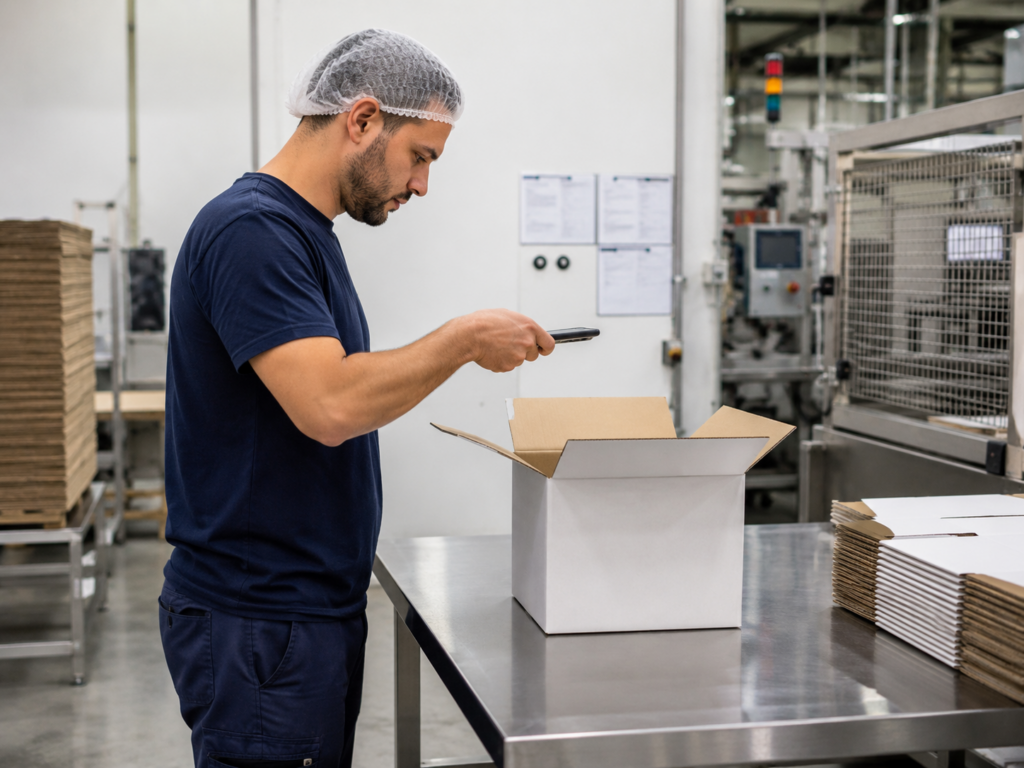
Do you still inspect products manually during final inspections? Are all intended parts installed correctly? Have all required components been fitted? Is the packaging filled correctly? Do colors, versions, and visible details meet the requirements? And are there minor damages, inconsistencies, or anomalies that can easily be overlooked in the rush of a final inspection? This is precisely where Vimmera AI Agents can provide valuable support for visual inspection. Based on a photo of the relevant product, component, or package, the agent assists with visual analysis. It can check whether components appear complete, whether components have been assembled correctly, whether required features or equipment are present, and whether recognizable deviations, anomalies, or potential defects are visible. This is particularly helpful…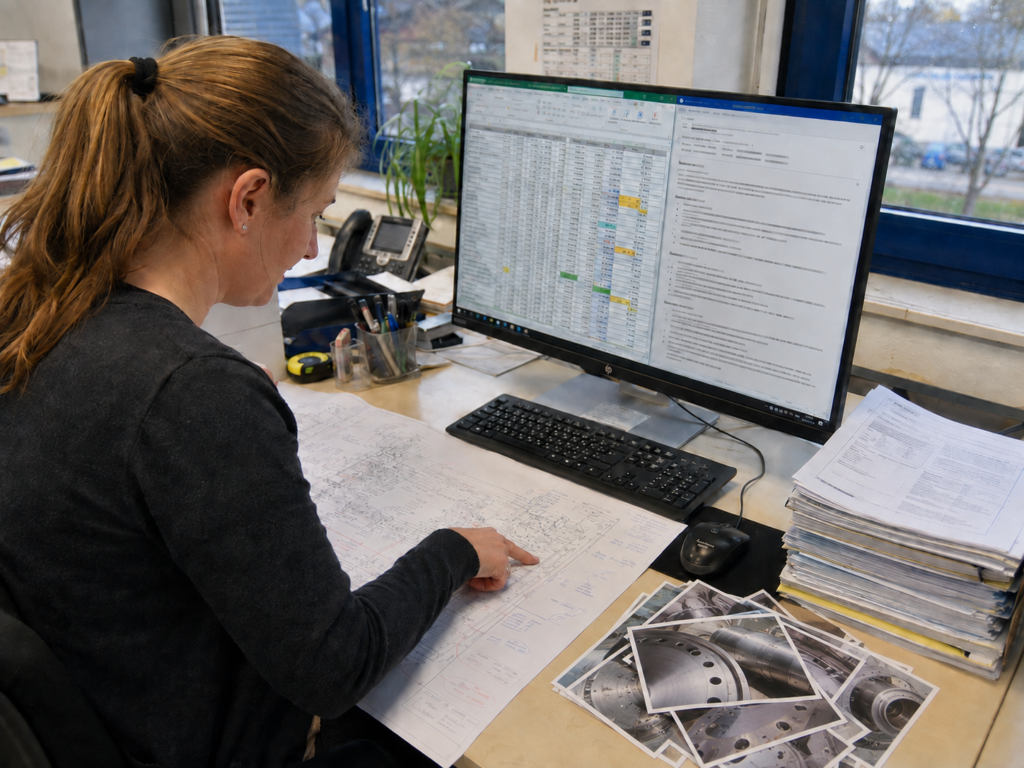
Plausibility checks and intelligent verification
Are you still manually checking various documents for logical consistency and accurate information transfer? Do the quantities in a plan match the order? Has a change also been taken into account in subsequent documents? Does the number of accessories match the intended main components? Do the details in contracts, expert reports, or minutes correspond to what is documented in drawings, tables, or photos? Such checks are often time-consuming, especially when relevant information is spread across many different files and document versions. Vimmera AI Agents handle exactly this task. They understand text, files, presentations, contracts, expert reports, tables, photos, and drawings. Handwritten notes, additions, and annotations within documents can also be included in the review. Information is not merely extracted. The…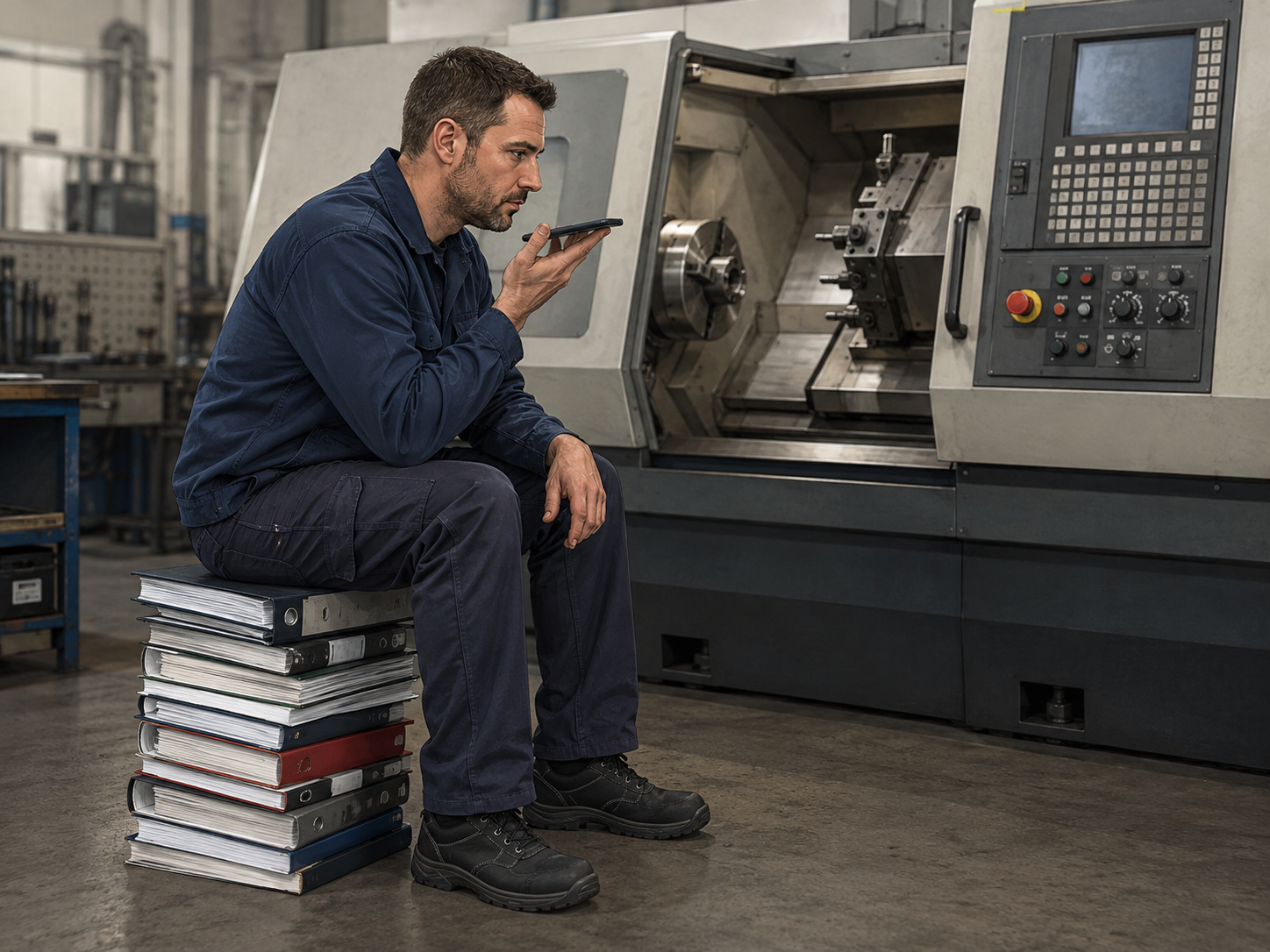
Digital twin
A digital twin is far more than a digital representation of a product, machine, building, or process. It combines information from different sources into an intelligently usable knowledge model. Documents, technical data, images, drawings, measurements, maintenance information, processes, and experience can be assigned to a real object or situation and linked together. This creates a digital twin that not only stores information, but also understands relationships and can answer questions. Don't search. Just ask. Knowledge in context Large volumes of information are generated in companies every day. They are found in documents, emails, databases, technical drawings, ERP systems, CRM systems, manuals, images, or in employees' minds. The problem is often not that information is missing. The problem is that it…
AI training: learning when it really suits you
Training is important. At the same time, it is often difficult to organize in day-to-day business. Dates have to be coordinated, employees are not always available at the same time, content is understood at different speeds, and follow-up questions often only arise later in the work process. With AI-supported training, continuing education becomes much more flexible, individualized, and effective. Vimmera AI can prepare training content so that employees can access it at any time: in the office, working from home, on the go, or exactly when there is time for it. The training no longer has to take place at a fixed appointment. It is ready when it is needed. This creates a new form of knowledge transfer: personal, interactive,…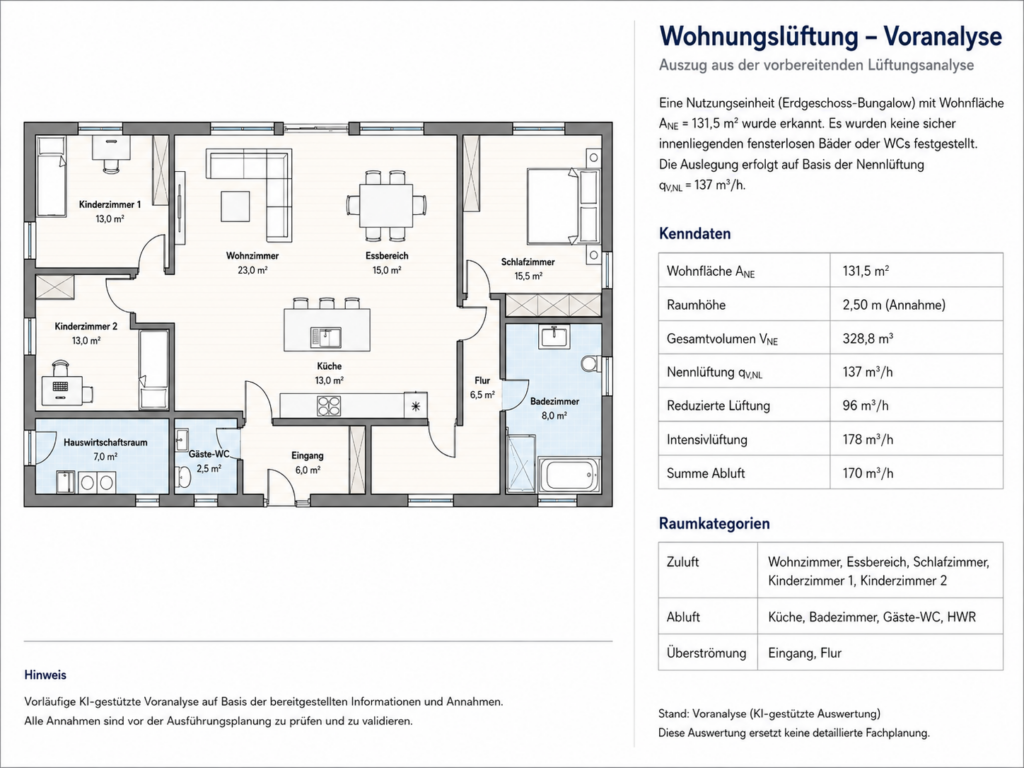
Technical planning
The introduction of an AI-powered planning assistant for residential ventilation units makes it possible to carry out technical calculations and planning processes in residential construction much more efficiently, in a more structured way, and with greater traceability. The goal is to digitally support the entire planning workflow, from the initial floor plan recognition through the determination of the required air volume flows to the selection of suitable ventilation units. A central component of the system is the automatic analysis of floor plans. These can be provided, for example, as a PDF, image file, scan, or photo. The AI recognizes rooms, room boundaries, wall runs, doors, windows, shafts, and other relevant structural elements. Existing dimensions are read out and used for…
Personal AI assistants
Another special use case are personal AI assistants for individual people within the company. These are individually customized AI agents that not only support general tasks, but can be specifically tailored to a particular person’s way of working, areas of responsibility, and communication style. Such a personal assistant can access approved company knowledge, for example internal documents, templates, product information, process descriptions, guidelines, customer information, or project materials. At the same time, it is specialized for the respective person. This enables the assistant to understand which tasks arise regularly, which wording is preferred, how emails are usually structured, which tone is used in communication, and how documents should be structured or prepared. A personal GPT assistant can, for example, help…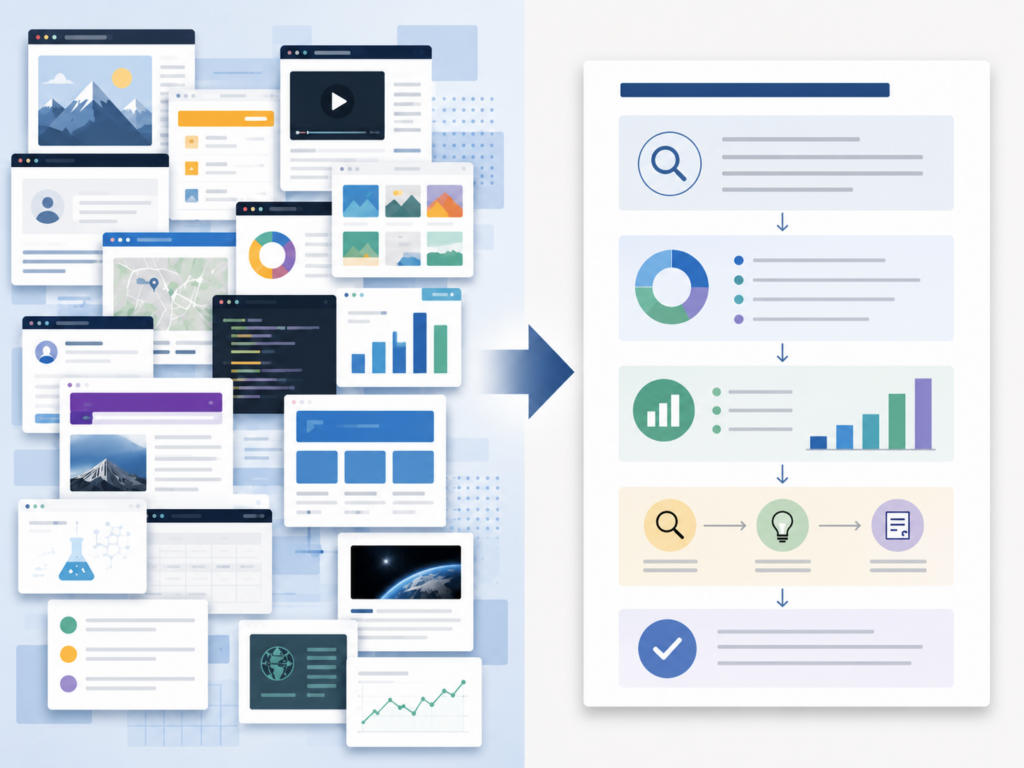
AI web search and research
Another useful application area is AI-powered web search and research assistants. They help companies find information from the internet much faster, more systematically, and more purposefully than with a traditional manual search. Ordinary internet searches are usually carried out via individual search providers such as Google. Users enter a search query, review the displayed results, open various websites, adjust their search terms several times, and then try to compile the relevant information from many individual sources. This process is often time-consuming, confusing, and heavily dependent on how well the original search query was formulated. An AI web search assistant goes much further here. The user merely describes the research goal in natural language. The assistant independently develops several suitable search…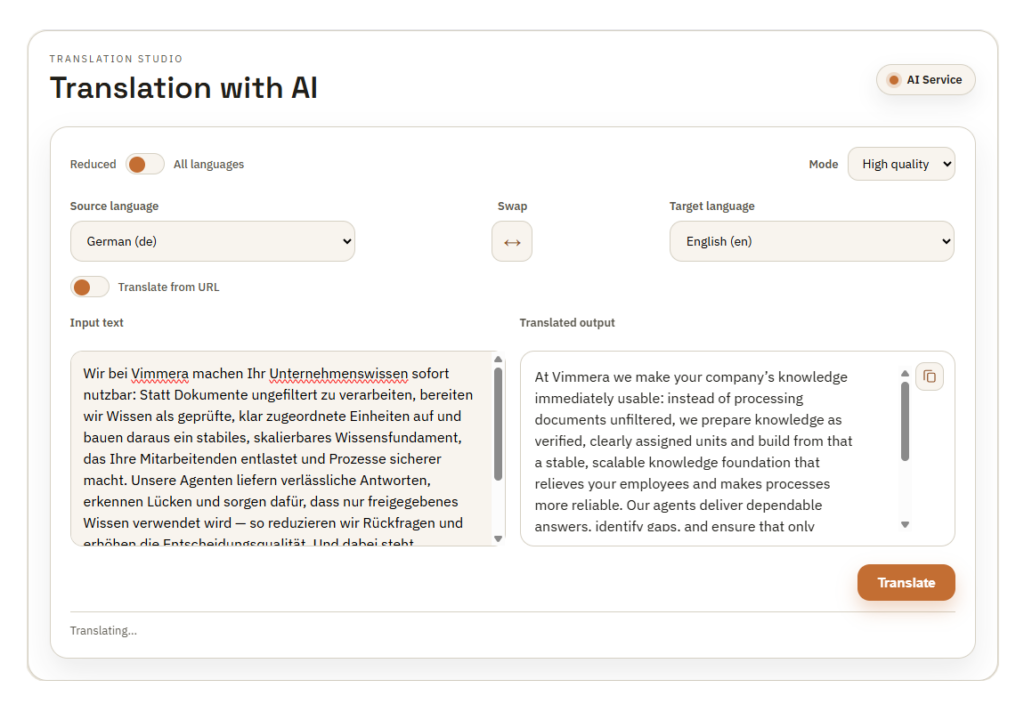
Translation tools
Today, almost any tool can translate texts into other languages. The real difference becomes apparent, however, when content needs to be technically accurate, linguistically natural, and truly usable in a business context. This is exactly where our translation tools come in. Our solution does not just translate any texts, documents, meetings, and conversational content into other languages. It also takes into account technical terms, product names, industry-specific wording, correct idioms, and country-specific characteristics. The result is translations that are not only linguistically correct, but also technically reliable and ready for direct use in international processes. Translate technical terms correctly in every language Many standard solutions translate words, but not the technical context. Especially with technical content, product descriptions, or internal…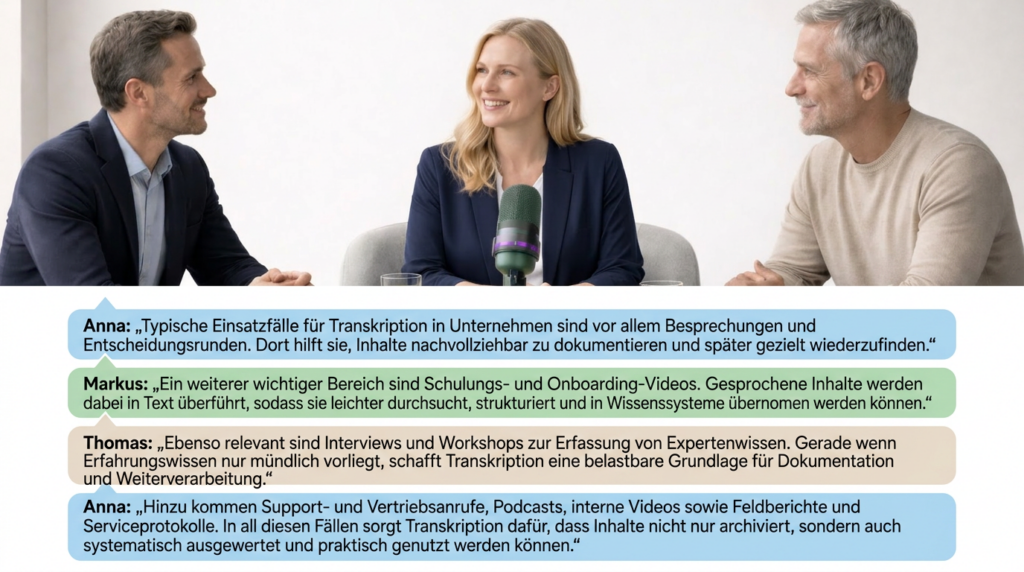
Speech to text
Converting speech into text is technically no longer a feat today. Transcribing conversations, voice notes, or meetings has almost become standard by now. The real difference therefore lies not in merely writing things down, but in understanding, structuring, assigning, and intelligently processing the content further. In addition, many solutions quickly reach their limits in practice: they require dedicated hardware, are based on closed systems, or can only be connected to existing applications and processes to a limited extent. With Vimmera Studio, Vimmera AI offers a significantly more flexible approach. Any mobile phone, tablet, PC, or laptop can be used directly – without additional hardware and fully integrated into Vimmera’s AI landscape. This is how Vimmera AI goes far beyond traditional…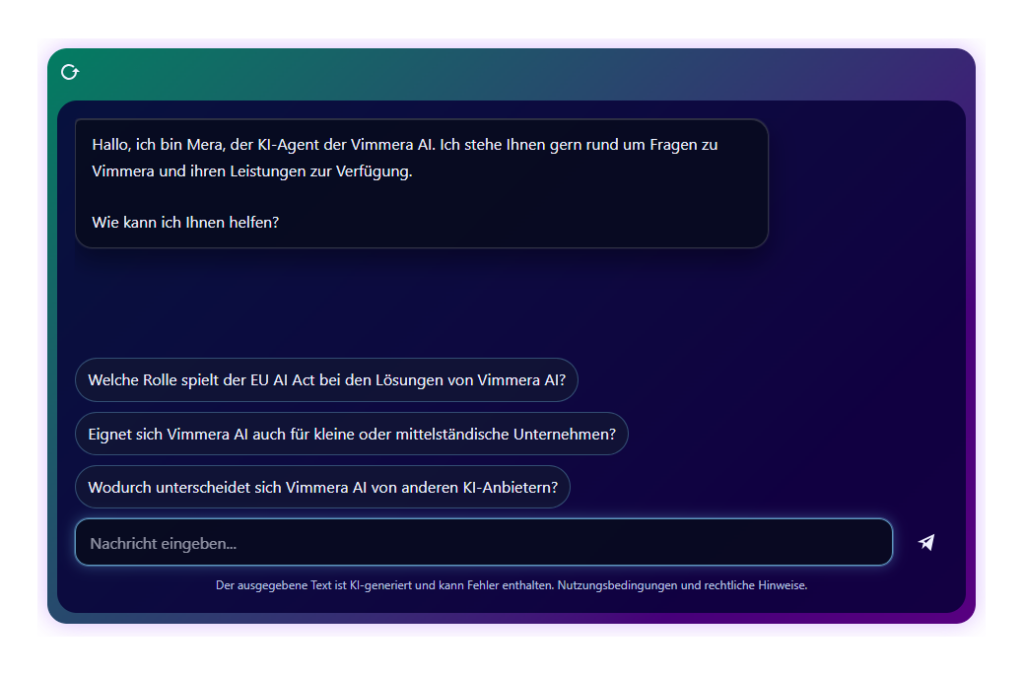
Chatbots for businesses
Chatbots have now become established in many companies. On websites, in customer portals, or in internal systems, they answer questions, assist with inquiries, or help make information accessible more quickly. But this is exactly where the crucial difference becomes apparent: a simple chatbot responds to known questions with predefined answers. An intelligent chatbot, on the other hand, understands content, recognizes connections, processes even complex inquiries, and accesses relevant knowledge in order to provide real help. Our intelligent chatbots therefore go far beyond traditional question-and-answer systems. They can use information from documents, product data, knowledge databases, and internal guidelines to answer inquiries precisely, contextually, and in a structured way. This is not just about standard cases, but also about complex topics,…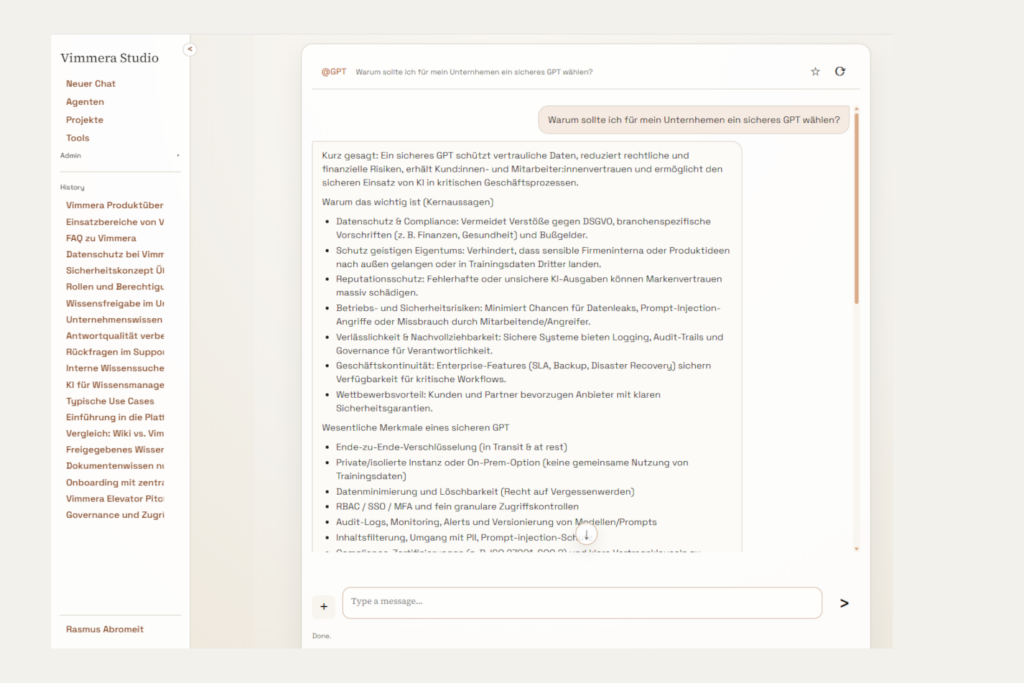
GPTs for Companies
The use of AI in everyday business is increasing rapidly. Employees use tools like ChatGPT, Claude, or other systems to create texts, analyze information, summarize content, or speed up work processes. However, this is exactly where a growing risk arises: shadow AI. This refers to the use of powerful AI tools outside controlled, approved, and data protection-compliant corporate structures. The result is potential data leaks, data protection violations, compliance risks, and a lack of overview of which information is being entered into external systems. What is shadow AI? Shadow AI is when employees independently use AI services without them being centrally reviewed, technically secured, or organizationally controlled. In practice, this often happens for understandable reasons: the tools are well known,…
Inspiration for Marketing
Creating marketing content has never been easier than it is today. Texts, social media posts, campaign ideas, or advertising content can now be generated in a short time with many tools. But that is precisely where the real challenge lies: if almost every application can generate content today, what is the real difference? The answer is simple: not in pure text creation, but in the ability to develop targeted, brand-compliant, and genuinely usable content for different channels and use cases. Our marketing tools therefore go far beyond simple text generators. They support companies in creating marketing campaigns, social media posts, advertising copy, content ideas, posts, ads, and other communication content such as images. This does not just produce quickly written…
Spare parts and product search
Searching for spare parts is significantly more time-consuming in many companies than it appears at first glance. Exact designations are often missing, item numbers are not readily available, product variants differ only in details, or important information is spread across multiple systems, documents, and sources of knowledge. This is exactly where the potential of an intelligent, AI-supported search becomes clear. With Vimmera Studio, a powerful product and spare parts search can be implemented through a combination of different agents that goes far beyond traditional search forms. Instead of merely executing rigid database queries, the system accesses company knowledge from a Cortex, understands relationships, and searches semantically for the right products, variants, accessories, or spare parts. This creates a solution that…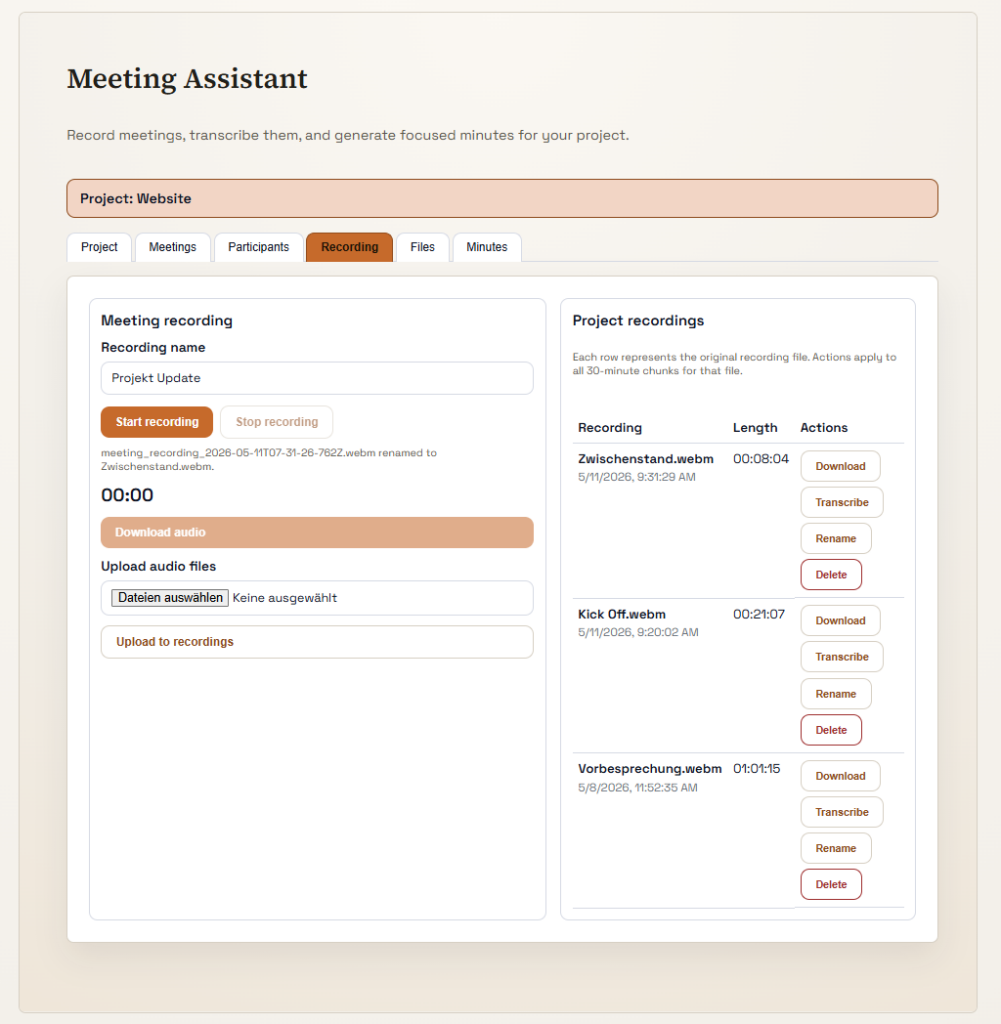
Meeting Assistant
Vimmera's Meeting Assistant shows how AI can immediately make everyday work easier. Meetings are no longer just documented, but automatically translated into structured, usable results. The application can be used directly at the workplace via PC or laptop, as well as on the go via smartphone or tablet. The devices' hands-free function is used for this, or a connected microphone is used. Additional hardware is not required. This allows the Meeting Assistant to be used flexibly in existing work environments, in the office, on the go, in the meeting room, or in mobile use. During a meeting, projects can be created, participants recorded, meetings managed, and relevant contextual information stored. The recording can be started directly or an existing audio…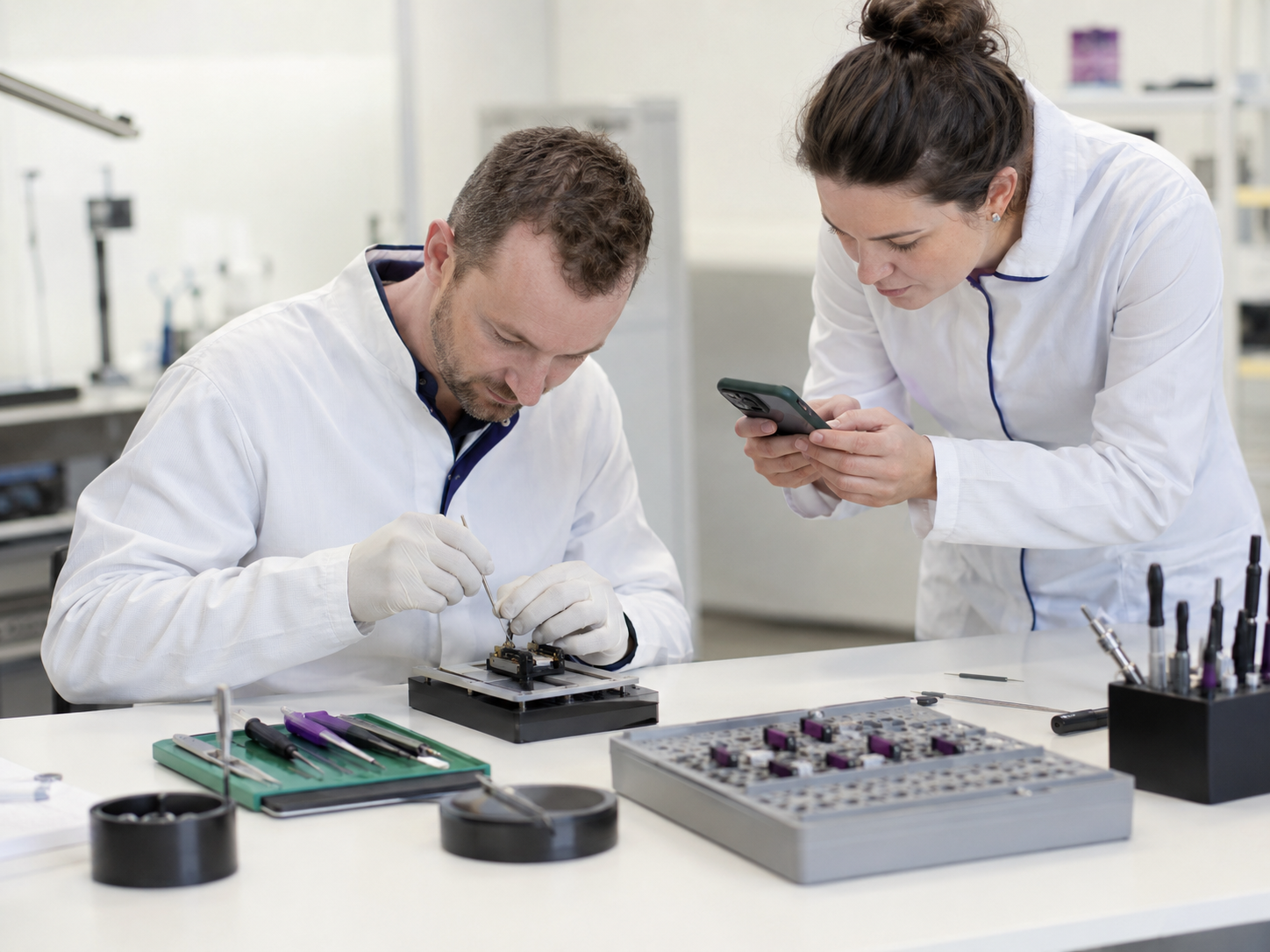
Create manuals and documentation by language
Manuals, instructions, process descriptions, and internal guidance are important for companies. They ensure that workflows remain understandable, knowledge is passed on, and employees can carry out tasks reliably. However, creating such content is often time-consuming. Processes must be described, steps documented, screenshots inserted, wording aligned, and content regularly updated. That is exactly why many manuals remain incomplete, outdated, or are never created at all. Vimmera simplifies this process with AI. Explain knowledge simply instead of writing it down laboriously With Vimmera's tools, employees can capture their knowledge directly by voice. They sit at the computer, go through a process, open documents, show work steps, or explain a specific task. In doing so, they simply describe what they are doing, why…
Interactive manuals and assistance with AI
Manuals, instructions, process descriptions, and help documents are indispensable in many companies. They explain products, procedures, systems, machines, internal rules, or frequently performed work steps. But in daily use, they are often difficult to access. Information is stored in PDF files, folders, wikis, intranets, or printed documents. Anyone with a specific question has to search, leaf through, read, and compare. This takes time and often leads to colleagues or support being asked again after all. Vimmera turns static manuals into interactive help systems. From manual to digital assistant With Vimmera, existing manuals, operating instructions, training materials, FAQ lists, process documents, technical documentation, and internal guidelines can be transferred into an AI system. The content is not only stored, but also…
Make onboarding and offboarding easier with AI
When employees leave a company, valuable knowledge is often lost. Processes, workflows, responsibilities, experience, and small details from everyday work are often known only to individual people. It is precisely this knowledge that is especially important for companies. With Vimmera's tools, this knowledge can be passed on easily, securely, and in a structured way. Employees do not have to write long handover documents or create complicated process descriptions. They can explain their work directly while sitting at the computer, reviewing documents, or carrying out a process. The system listens, recognizes connections, and makes the information available for future users. Capture knowledge easily by voice The handover begins very simply. Turn on the microphone and explain what is being done. The…
Making company knowledge accessible to everyone
Every company generates valuable knowledge every day. In documents, presentations, meetings, training sessions, projects, processes, customer inquiries, and in the minds of employees. Yet this knowledge is often not available where it is needed at that moment. Information is scattered across different systems, folders, files, or departments. Some content is difficult to find, while other information is known only to certain individuals. This costs time, complicates decision-making, and makes companies dependent on individual knowledge holders. Vimmera makes company knowledge centrally available and easy to use with AI. From scattered information to usable knowledge Existing information is not only collected, but also structured, linked, and transferred into a shared knowledge space. Documents, minutes, presentations, training materials, process descriptions, images, videos, and…