Vimmera Assist
Vimmera Assist: Putting corporate knowledge to work through conversation
In modern businesses, communication is a crucial part of value creation. It influences workflows, decisions, and customer experiences. At the same time, expectations are rising: answers should be fast, accurate, and consistent across all channels—both in customer service and in internal collaboration.
Traditional chatbots often rely on fixed rules and limited FAQ collections. As soon as a question combines several topics, requires specialist knowledge, or concerns a company’s specific context, they quickly reach their limits.
Vimmera Assist goes a step further: as a context-aware AI assistant, it connects natural communication with a company’s knowledge and processes. It can make information accessible to employees and customers, support workflows, and, depending on its configuration, perform actions in connected systems.
The interface to your corporate knowledge
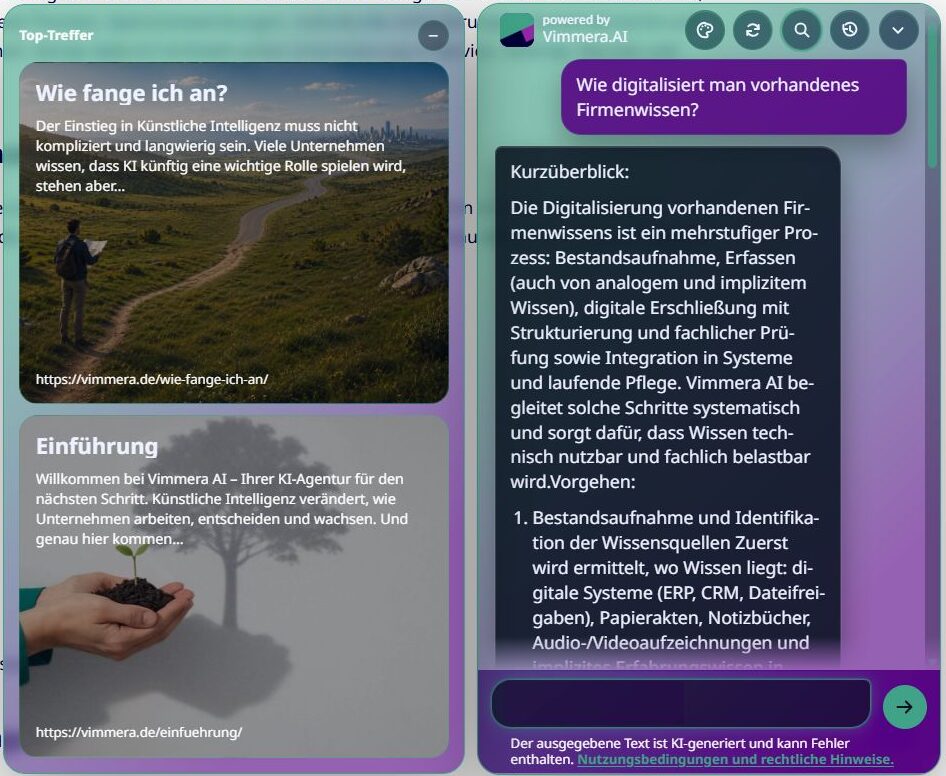
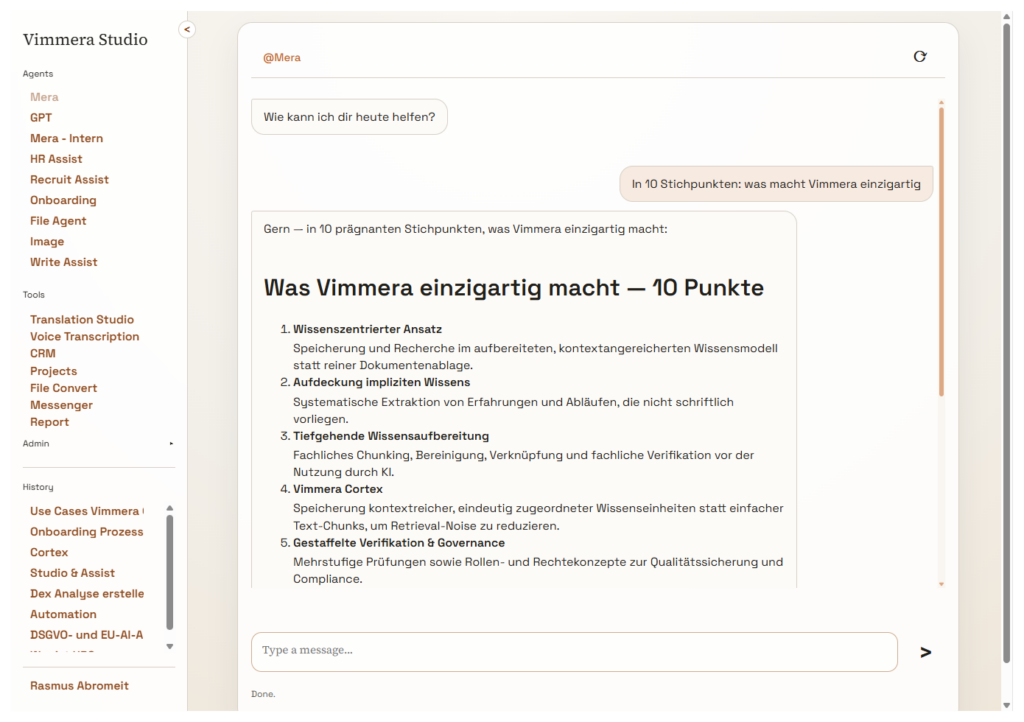
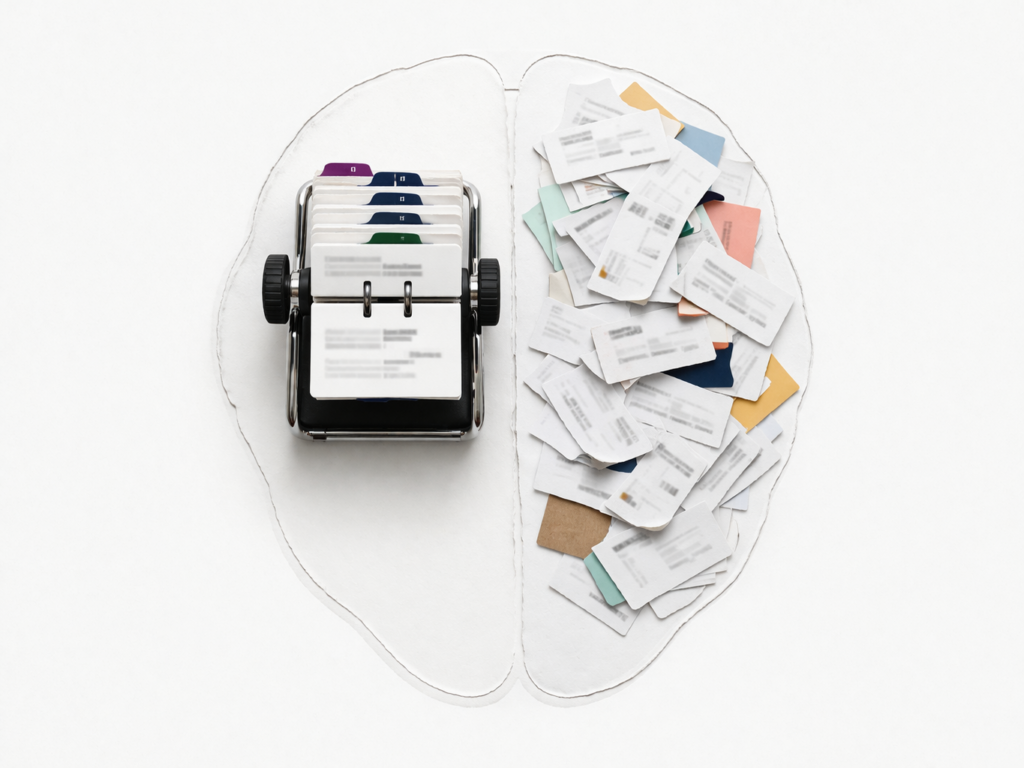
An assistant can serve as a direct interface between people and a company’s knowledge. Users don’t need to know which folder a document is in, how a database is structured, or which search terms to use. They ask their question in natural language—Vimmera Assist searches the relevant knowledge space in Vimmera Cortex and clearly brings together the information relevant to the specific request.
Whether an employee is looking for an internal policy or a customer has a question about a product, service, or service process, the assistant can specifically access the relevant knowledge base maintained in Cortex. This makes information easier to find and available where it is needed.
Vimmera Cortex provides the structured, company-specific knowledge base. Vimmera Assist uses this content to align its answers with your company’s knowledge and guidelines—instead of relying solely on general information.
More than a traditional chatbot
Vimmera Assist doesn’t process requests solely according to rigid if-then rules. It analyzes the meaning of a question, takes the available conversation context into account, and searches the approved knowledge sources for relevant content.
This allows answers to be tailored to the specific use case. Depending on the application, the assistant also takes roles, permissions, internal rules, and data protection requirements into account. This means users receive the information they need for their specific task and are authorized to access it.
The language can also be adapted to your company’s terminology. Technical terms, abbreviations, product names, and brand-specific spellings can be used consistently. This supports clear communication and helps prevent misunderstandings.
Understanding knowledge and putting it to work every day
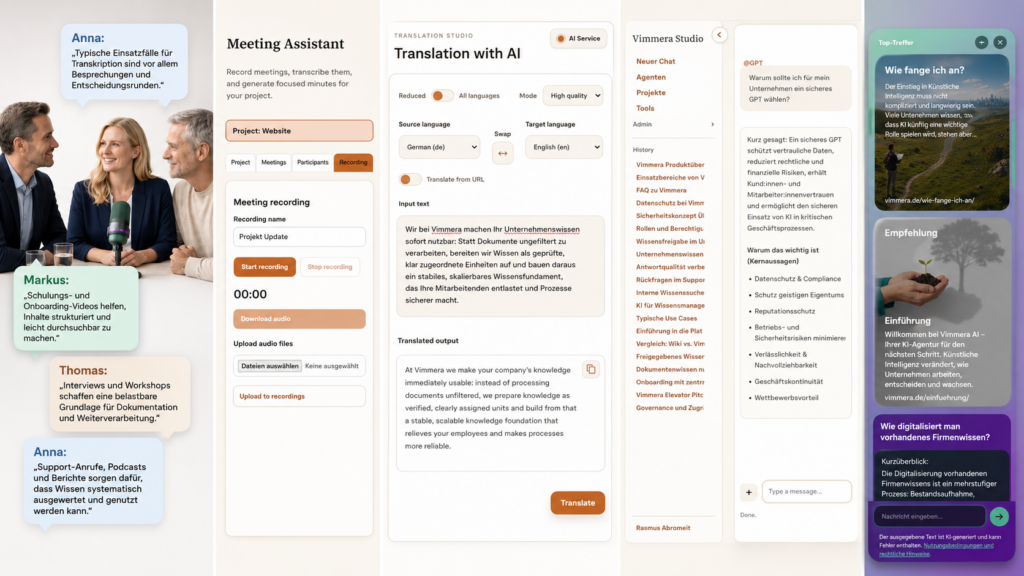
In customer service, Vimmera Assist can provide consistent information about products, services, and processes. Internally, it helps employees find information from documents, policies, and knowledge collections more quickly and put it to use in their work.
Extensive documents can also be incorporated into knowledge work: for example, the assistant can analyze expert reports or documents, highlight relevant passages, and provide guidance on further processing. On request, it can also help create texts, documents, and emails.
Since the answers are based on the content maintained in Vimmera Cortex, companies can update their knowledge base centrally and make it available for a range of use cases.
From knowledge to action: handling emails and processes
Vimmera Assist can go beyond simply providing information and extend into a company’s digital work environment. With suitable integrations and appropriately configured permissions, it can receive and send emails, analyze information, and conduct multi-step conversations.
First-level support is one example: the assistant receives customer inquiries, checks incoming emails, identifies the issue, and asks targeted follow-up questions when information is missing. It can assign documents to the relevant cases and—depending on the connected processes—perform calculations or prepare a quote and send it back to the customer. Employees can be brought in when needed, for example for approvals or complex cases.
This makes it possible to handle recurring tasks in a structured way, without inquiries getting stuck because of a rigid FAQ selection. The conversation and next steps can be guided by the actual request.
Natural language for CRM and ERP systems
Vimmera Assist can also be connected to CRM and ERP systems. Depending on the interface and permissions, it can retrieve, summarize, create, or prepare data for further processing using natural language.
For example, employees could ask: “Which customers have had a particularly high number of support cases in the last three months?” The assistant can analyze the available CRM data and present the results as an overview or statistics. It can also document customer conversations, add information, or prepare data for another process.
An analysis can also lead to a next step if desired: for example, Vimmera Assist can prepare a presentation based on the results and add it as an email attachment—provided the relevant functions have been configured and approved. The actions available depend on the existing interfaces, configured rules, and the permissions of each user.
A programming assistant for everyday work
Vimmera Assist can also support programming teams. It helps design, explain, and revise code, and can contribute to the development of scripts, prototypes, and applications.
This makes software development accessible to more people in the company: small digital tools for recurring tasks can be planned and implemented more quickly. More complex applications can also be planned and developed together with the assistant. Expert review, testing, and approvals remain part of the development process.
Security, data protection, and governance
Corporate communications often involve confidential or sensitive information. That is why data security, data protection, and clear responsibilities must be considered when using an assistant.
Vimmera Assist can be restricted to approved knowledge sources and functions. Role- and permission-based access concepts, as well as input and output rules, help adapt access and processing to the company’s requirements. Answers should be based on traceable information and phrased in an objective, consistent, and appropriate way.
This makes it possible to align the use of the assistant with existing governance and compliance requirements.
Integration into existing work environments
An AI assistant is especially useful when it fits into the workflows employees already use. Vimmera Assist can be embedded in existing IT structures and work environments. The knowledge base resides in Vimmera Cortex; additional systems and interfaces can be connected for more advanced actions, where available and configured.
This allows the assistant to bring knowledge and work steps together without users having to switch between multiple disconnected tools for every task.
What can Vimmera Assist be used for?
Customer service and support
- Answer customer inquiries—with assistance or through automation within clearly defined workflows
- Resolve questions about products, services, and support
- Gather relevant information for complex inquiries, such as searching for replacement parts
- Review incoming emails, ask follow-up questions, and assign documents to cases
- Perform calculations and prepare quotes
- Provide service information outside regular business hours
Internal knowledge work
- Find relevant information in documents and policies more quickly
- Support employees with specialist questions in their day-to-day work
- Analyze expert reports and other documents and provide guidance on how to handle them
- Help create expert reports, documents, and emails
Communication and business processes
- Provide consistent answers to recurring questions
- Make information available across departments
- Retrieve and process CRM and ERP data using natural language
- Document conversations, cases, and information in connected systems
Development and automation
- Explain, design, and revise code
- Develop scripts and small software tools
- Build prototypes and applications step by step
Regulated or sensitive use cases
- Take roles, permissions, and approved information sources into account
- Align answers with internal rules and data protection requirements
- Support processes with traceable control and approval rules
Vimmera Assist as a strategic advantage
Vimmera Assist combines modern AI with Vimmera Cortex’s company-specific knowledge base and, where appropriate and technically feasible, with your company’s systems and workflows.
The result is more than just another chatbot: a digital gateway to corporate knowledge that supports people with specific tasks and can turn information into actionable results. Companies can make knowledge more accessible, standardize communication, and provide targeted support for recurring workflows.