
What do an approval process, a spare parts list, and a meeting have in common?
They are all part of a company's knowledge.
Company knowledge is not just found in documents and databases. It is created through decisions and conversations, in processes and specialist systems, in technical documentation, and in employees' experience.
All this knowledge shapes how a company works, makes decisions, and acts.

When information becomes context.
In a meeting, someone mentions a component needed for an older product.
The spare parts list shows which variants it was used in. The technical documentation shows which properties are relevant to its use. The inventory management system shows which parts are still available.
Only when these pieces are connected does the component name become a useful starting point: it becomes clearer what is being discussed, which variants are possible, and what is currently available.
The process can move forward without the people involved having to search for each piece of information individually.

More is needed to make the right decision.
That still doesn't establish whether an available part is actually suitable.
Now, information originally created in other contexts becomes important. Previous service cases may document that a variant caused problems under certain conditions. An existing approval may allow or rule out an alternative. Technical specifications set the limits for its use.
Only with this knowledge can it be decided which variant can actually be used.
The decision therefore depends not only on product data, but also on experience and rules established elsewhere.

Information becomes a workflow.
Once the right variant has been identified, technical review, approval, documentation, and ordering can all build on the same information base. The context does not have to be re-established at every step.
What would otherwise have to be reconstructed through multiple searches, follow-up questions, and handoffs remains part of the process.
This reduces reliance—especially for rare or complex tasks—on a single person knowing every variant, past decision, and special case from experience.
Experience remains important, but it does not have to be available only when the experienced person is directly involved.
This turns scattered knowledge into a workflow that can use that knowledge across multiple steps.

This is exactly where AI becomes a working tool.
This process requires information that exists in very different technical formats to be brought together.
What is expressed as speech and context in a meeting appears as structured data in the spare parts list, as text, tables, or drawings in technical documentation, and as records in other systems for previous cases.
Artificial intelligence can relate these different formats to the same task.
For the component, this means connecting the name mentioned in the conversation with product data, technical specifications, documented experience, and current inventory.
The time-consuming work is not a single search, but gathering relevant information from different sources, comparing it, and assessing it in the context of the specific task.
AI can help with exactly this work.
The company remains responsible for the subject-matter decision. AI helps make the information needed to support that decision available and verifiable.
This principle becomes a concrete software solution.
Not every company works with the same systems, data, and processes. That is why the right AI application cannot be reduced to a rigid, one-size-fits-all solution.
Vimmera builds applications on its own technical foundation, adapting them to the specific task, available knowledge sources, and existing processes.
Where existing components are sufficient, there is no need to redevelop basic functions for every project. Where the task requires it, the software can be customized or developed from scratch.
The result is neither an off-the-shelf solution nor a system that has to start from scratch for every requirement.

Making it work in your company.
In practice, company knowledge cannot be combined indiscriminately.
Current inventory must come from the designated inventory management system. Technical approval may only be taken from an authoritative source. Access rights determine who can see and use which information. And it must remain possible to trace the basis for a result.
That is why data sources, permissions, approvals, and interfaces are not added as an afterthought; they are part of the application and its workflow.
Existing systems can continue to be used and integrated where needed.
The technical environment is also tailored to the application. Depending on the requirements, processing can take place in suitable cloud environments, on the company's own infrastructure, or locally.
This does not create a separate AI world alongside existing processes, but a tool that operates under the conditions that actually apply in the company.
Meetings and project knowledge
It often starts with a conversation. Meetings are where decisions are made, tasks are assigned, and connections important to the work ahead are discussed.
But after the meeting, this information is often spread across minutes, personal notes, and individual messages. Anyone who wants to revisit something later first has to find the right place.
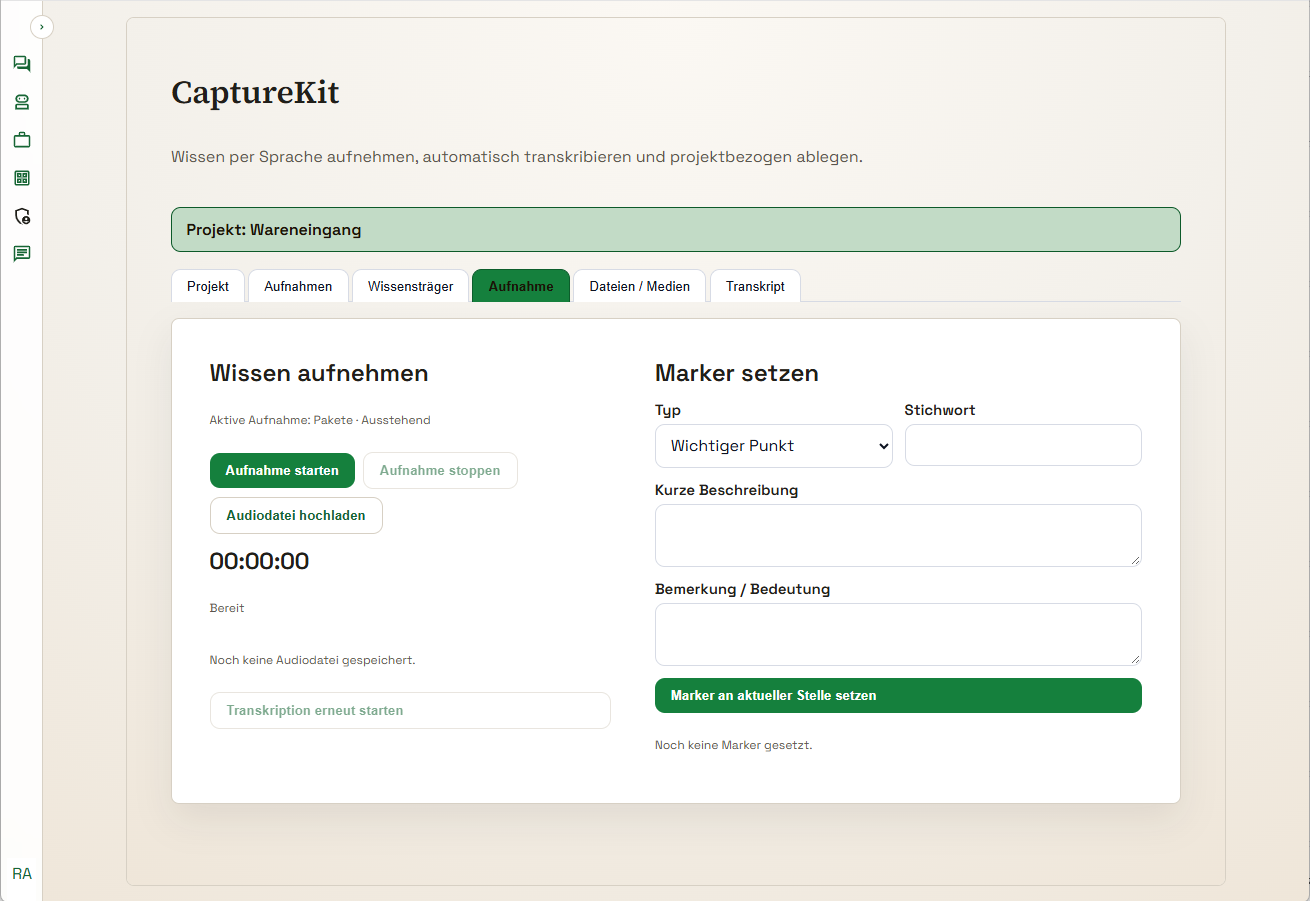
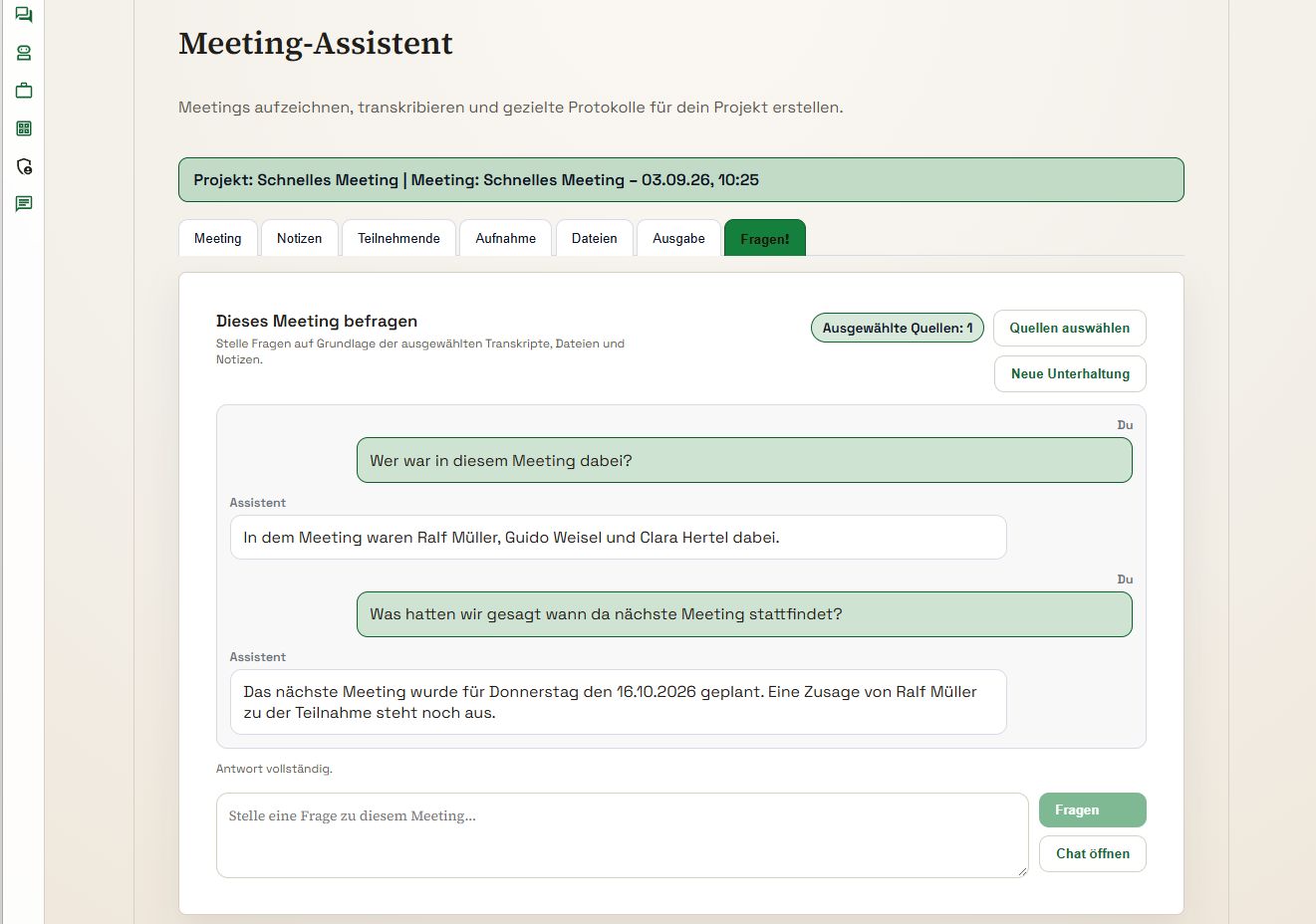
A suitable application can record and transcribe conversations and assign their content to a project. Decisions, tasks, and open questions remain available and can be queried as needed. Relevant information can also be revisited in later meetings.
This turns a meeting into more than just minutes: it becomes a knowledge base that remains useful throughout the rest of the project.
Technical planning
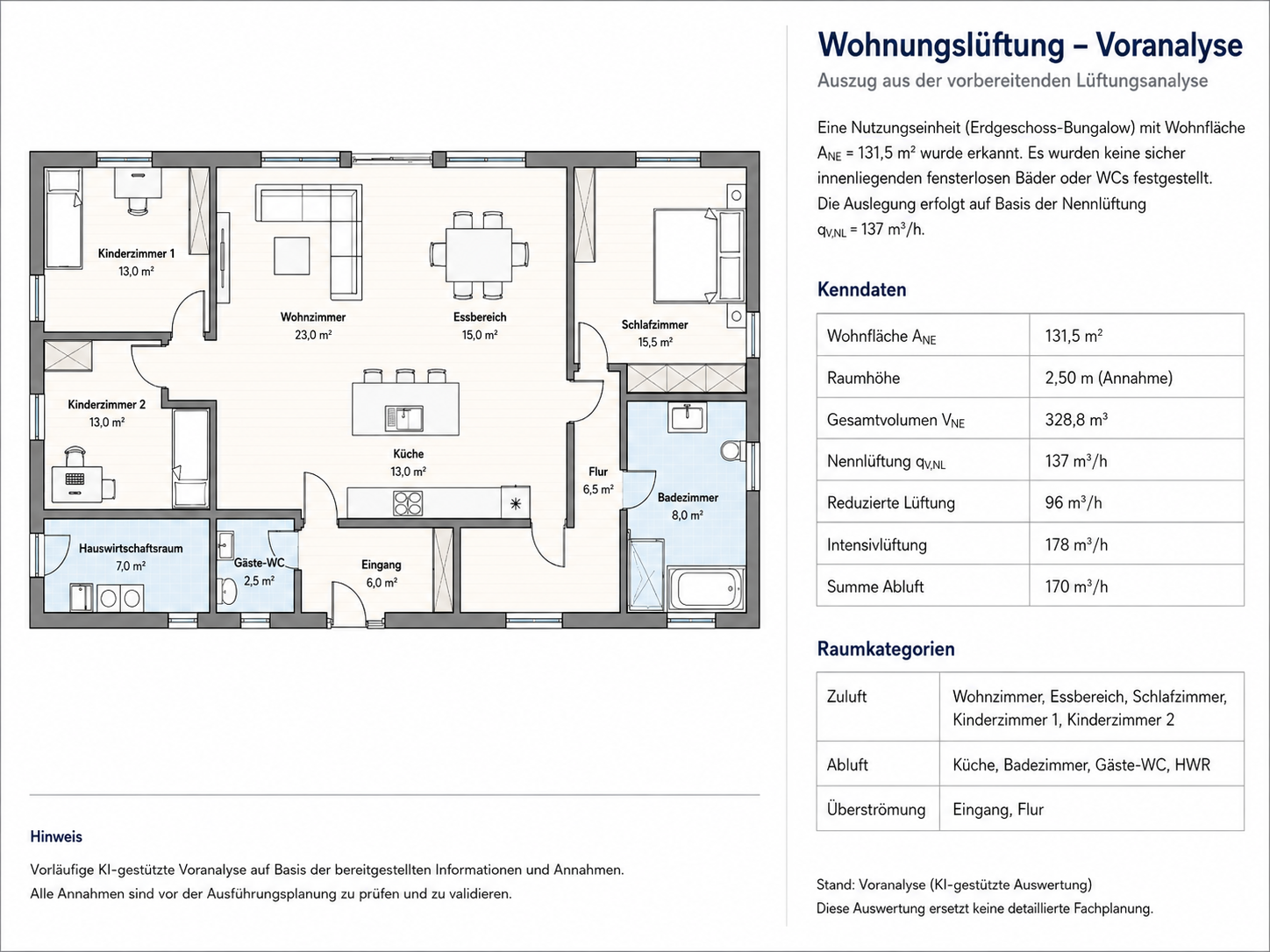
Technical planning often requires bringing together information from different sources. Requirements are in documents, technical specifications in tables, and important details in drawings or existing systems.
This information belongs together, but it is often handled independently. Anyone who needs a complete overview first has to find and compare the relevant details and put them in the right context.
An application tailored to this work can analyze different information sources together, reveal technical relationships, and answer specific questions about the available documentation.
This creates a shared information base for preparing plans, understanding decisions, and building on them in subsequent steps.
Intelligent checks
Whether dealing with invoices, technical documentation, or extensive documents, information often needs not just to be read, but checked against specific requirements and relationships.
For example, an invoice must match the purchase order and delivery note. Technical documentation must comply with certain specifications. And in extensive documents, it may be crucial to determine whether statements agree or contradict one another.
An intelligent application can bring together the relevant information, check it against defined criteria, and flag possible discrepancies or missing details.
Results remain traceable to their sources. This allows employees to focus on the items flagged, instead of having to compare all the documents in full over and over again.
From task to application
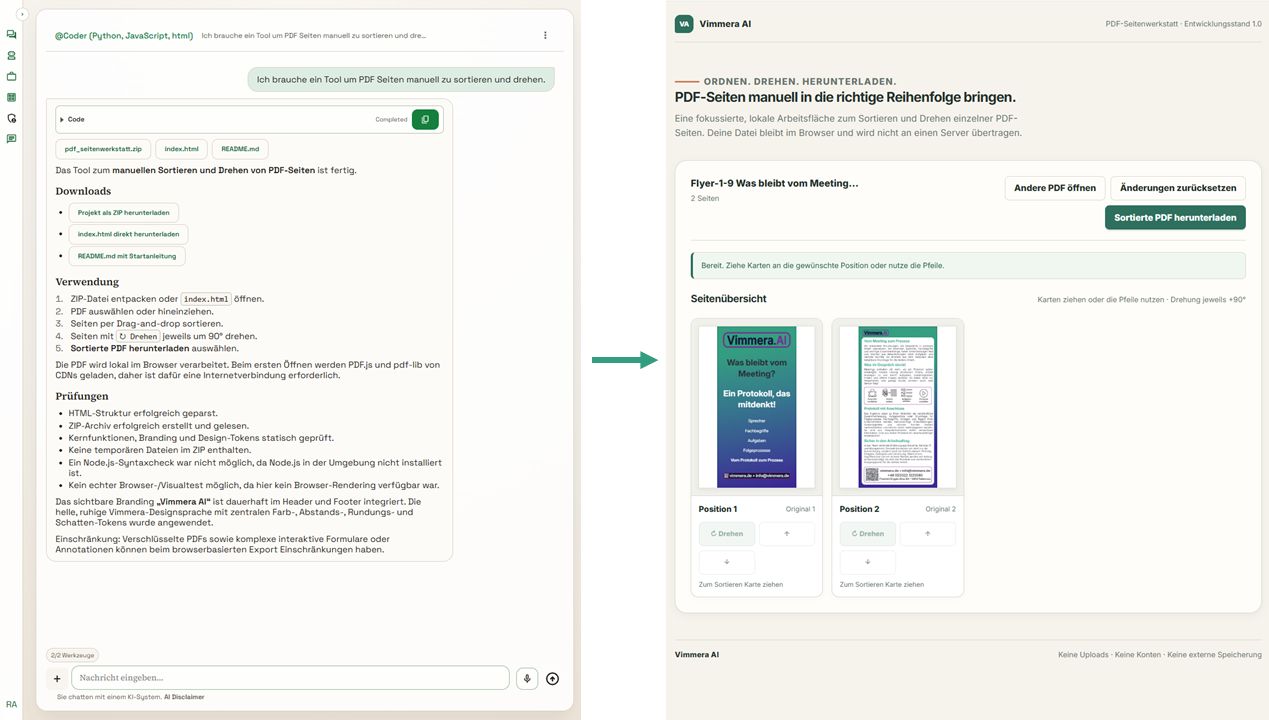
These examples show how varied the tasks can be for which AI-powered software is used. Sometimes the goal is to make knowledge from conversations available; other times, it is to understand technical relationships or check information in a targeted way.
What matters is not having the widest possible range of features, but having an application that meaningfully supports a specific task and fits into the existing work environment.
From this, we develop products tailored to these tasks. Depending on where they are used in a company, different areas of application emerge.
When this becomes a concrete project, we begin the joint process of development and implementation.

What could this look like in your company?
What could this look like in your company?
Perhaps your company also has tasks that require information to be gathered again and again, documents to be compared manually, or processes to be coordinated with considerable effort.
Everyday tasks like these often offer opportunities for meaningful digital support. That does not mean an entire business process has to be changed.
Together, we look at what information is needed, where it is currently located, and how it can be turned into a workflow that genuinely supports the people involved.
The starting point is not ready-made software, but a specific task from your company.
We start with the tasks where knowledge is currently spread across people, documents, and systems, and explore how it can be turned into a useful digital workflow.