Implementation
Vimmera AI is more than a software provider: We are your AI agency and support you with our knowledge and experience.
We offer a complete enterprise solution for the introduction, operation, and sustainable use of AI systems. In doing so, we support companies of every size and every level of digitalization. Whether a small sole proprietorship or a large corporation, every company benefits from the use of AI systems in daily operations.
Particularly important: You need hardly any resources of your own for this.
If desired, Vimmera handles the implementation from start to finish and reduces your internal effort to a minimum. Your employees are only involved selectively. For example, for defining objectives, answering subject-specific questions, or approval. We take care of project management, technical implementation, and secure operation for you.
What exactly you receive from us:
- Goal and potential analysis: Identification of the most meaningful AI use cases, including benefits, effort, and prioritization.
- Data and knowledge development: Collection, structuring, and verification of company knowledge (documents, processes, products, case experience).
- System selection & architecture: Suitable AI models, tools, and components. Naturally, everything is aligned with security, data protection, and compliance requirements.
- Secure integration: Connection to and integration into existing systems and workflows (e.g. CRM, ticketing, email, knowledge databases), including role and authorization concepts.
- Operation and further development: Monitoring, quality control, updates, continuous optimization, and scaling for a system that grows (alongside your business).
- Introduction and acceptance: Training, guidelines, and acceptance measures so that AI is truly used in everyday work.
This creates an AI-based system that measurably improves processes, reduces risks, and creates long-term added value “from a single source,” tailored to your company and your framework conditions.
At this point, we have listed and described in detail every step that is normally necessary for the introduction of an AI system as an example. Of course, these are only examples; we take a close look at every company and every process and coordinate everything precisely. But to get an initial idea and be able to assess what to expect, the following information is exactly right for that:

1. Getting to know each other
The use of artificial intelligence in companies does not begin with technology, but with understanding.That is why every collaboration with Vimmera AI starts with a structured introductory meeting. This meeting is intended to truly understand your organization, your challenges, and your goals. It is not a sales presentation or a technical questionnaire, but a professional exchange between our companies. At the same time, you also get to know us. We introduce you to Vimmera AI, our way of working, and our technological approach in a way that gives you a clear picture of how collaboration works and what the use of AI in your company actually means. Of course, there is also room for all your questions. Use the conversation…
2. The process workshop
After the initial introduction and a decision in favor of AI in the company, the next crucial step follows: the analysis meeting or the process workshop. Depending on the size of the company and the complexity of the processes, either a comprehensive discussion (the analysis meeting) or a workshop with several people and, if necessary, over several days is required.In the workshop or analysis meeting, the focus is no longer on getting to know each other, but on systematically and jointly understanding your organization and your processes. In this step, we begin with the structured company analysis based on DEX (Digital Experience & Execution). DEX is the analysis and impact framework of Vimmera AI, which we use to specifically identify…
3. The DEX Analysis
The DEX analysis (Digital Experience & Execution) is the foundation of every successful AI implementation with Vimmera AI. It creates an objective, reliable picture of how your organization actually works. After the analysis meeting, upon request, we jointly conduct a complete DEX analysis of the processes and work steps in your company or organization. In doing so, we achieve a significantly higher level of detail than in the analysis meeting itself. While many projects are based on assumptions, individual opinions, or isolated process descriptions, DEX captures the full reality of work: information flows, processes, systems, interfaces, sources of knowledge, and human ways of working are examined together and placed in a clear context. What is the DEX analysis for? The…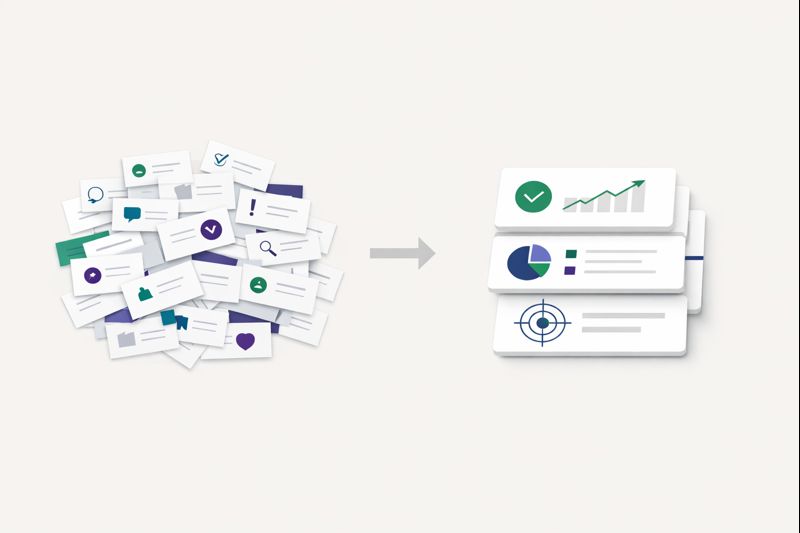
4. The Knowledge Collection
Before AI can use, understand, and reliably provide knowledge, that knowledge must first be captured completely and correctly. That is precisely why the systematic collection of company knowledge is one of the most important steps on the path to a functioning AI solution. This is explicitly not about simply uploading documents into a database or an “AI folder.” Such storage creates files, but not usable knowledge. Documents contain content, but usually very little of the context that is crucial for professional use: In which process does this information apply? For which role? Is it up to date? What exceptions exist? What experiences have employees had with it? An AI that only accesses uploaded files can find text passages, but it…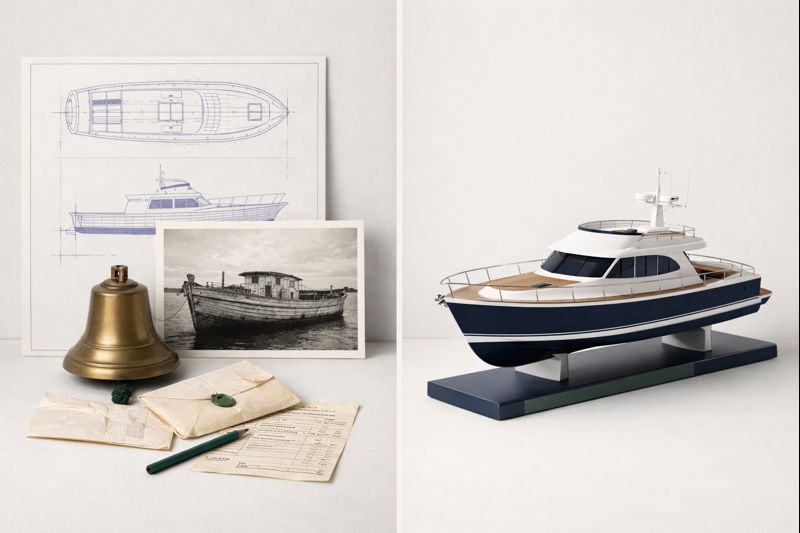
5. Data preparation
Once the company knowledge has been fully collected, the step begins that will largely determine how powerful, reliable, and useful the later AI will actually be: the data preparation. In this phase, a large number of individual files, texts, media, system extracts, and experience reports are turned for the first time into a coherent, structured, and professionally robust knowledge system. This is where Vimmera Cortex comes into play. Our knowledge base with a very special data structure. The collected information initially exists in very different qualities. Often there are multiple versions of the same content, contradictory statements, outdated versions, informal working methods, inconsistent terminology, or missing links between related topics. Much of it has grown historically, is not maintained consistently,…
6. Data verification
After the company knowledge has been collected and, in the data preparation for Vimmera Cortex, structured, cleaned, and linked together, the step follows that turns information into truly reliable knowledge: data verification. In this phase, it is decided which content may actually be considered valid, binding, and actively usable. Because even technically perfectly prepared data is not yet a solid foundation without expert review. In every organization, official rules, established practice, individual experience, old documents, and new guidelines exist in parallel. These often contradict one another or apply only in certain contexts. If an AI were to treat all of this information equally without filtering, it would inevitably produce incorrect, outdated, or contradictory statements. Data verification ensures that the knowledge…
7. Data embedding and data vectorization
After knowledge has been collected, prepared, and verified, the next step follows, which ensures that the AI can later access this knowledge quickly, precisely, and with the right context: Chunking, embedding, semantic preparation, and the creation of vector databases (vector stores). This step is the technical core that ensures the AI does not search “somewhere,” but instead specifically finds the right knowledge, even when users use different words, abbreviations, or ask incompletely. It largely determines whether answers are stable, reproducible, and technically sound. What happens in this step? In this step, the verified knowledge base is transformed into a form that an AI can search efficiently and use reliably. First, content is broken down into smaller, thematically coherent knowledge units.…
8. Selection of the LLM or LLMs
Once knowledge has been structured, verified, and technically prepared so that it can be found and used precisely (i.e., once your company-specific Vimmera Cortex has been built), the next central step follows: the selection of the Large Language Models (LLMs). LLMs are the “thinking machines” behind the AI. They determine how language is understood, how texts are generated, how logically arguments are made, and how flexibly the system can respond. Vimmera AI does not select these models in a blanket way, but together with you and based on your specific requirements. Because there is no single best model. There are large and small models, very creative and very precise models, fast and resource-efficient models, as well as highly specialized models…
10. Implementation of security mechanisms
In addition to selecting and combining the appropriate LLMs, another important step is implemented depending on the requirements and area of use: the implementation of additional security mechanisms. Because your knowledge is valuable, and it deserves the same protection as any other business-critical system. Vimmera AI does not view security as an option, but as an integral part of a professional AI architecture. Depending on the sensitivity of the data, legal requirements, and use cases, different layers of protection are activated and combined. What happens in this step? In this phase, technical and organizational protective mechanisms are integrated into the AI pipeline, both before processing by an LLM and after a response is generated. On the input side, filters are…
9. The Prompt Engineering
Once the LLM setup has been selected, the next step follows: prompt engineering. In this phase, it is determined how the AI thinks, responds, and acts. Vimmera AI handles this step in close coordination with you, because this is not about technology, but about how your AI represents your company internally and externally. An AI consists not only of data and models. It needs clear rules by which it uses this knowledge. These rules determine how it formulates responses, how it handles uncertainty, how deeply it answers, how empathetic or factual it appears, and how it deals with sensitive topics. This is exactly where the personality and reliability of your system are created. What happens in prompt engineering? In prompt…
11. Additional data sources and interfaces
Depending on the use case, it may make sense or be necessary to supplement the knowledge base from documents and verified company knowledge with additional data sources. These include, for example, databases, business systems, and other data interfaces that can be connected via modern integration standards such as MCP. The reason is simple: not everything an AI is supposed to answer or do is contained in documents. Many important pieces of information are “live” and constantly changing, such as prices, inventory levels, customer status, transaction data, tickets, delivery dates, master data, or project information. For the AI to work reliably here, it needs controlled access to the systems in which this data is provided. What happens in this step? In…
12. Adjustment of the user interface
For AI to be effective in a company, it is not enough for it to work technically. It must be available where employees actually work. That is why Vimmera AI relies on browser-based frontends such as Vimmera Studio and Vimmera Assist. Browser-based solutions offer decisive advantages: They work on almost all devices, without local installation, without complex updates, and without extensive IT intervention. Whether in the office, working from home, or on the go, access to AI is possible everywhere, secure, and always up to date. New functions are available immediately, without IT departments or users having to take action. What happens in this step? In this step, the user interface is defined, customized, and integrated. The goal is not…
13. Rollout of the AI systems
Once all the technical, content-related, and organizational foundations have been established, the rollout phase begins. In this step, the AI is not simply “switched on,” but introduced into the real working environment in a controlled, supported, and coordinated manner. The goal is for the AI not only to function, but also to be understood, accepted, and used meaningfully by employees. That is why the introduction takes place in close coordination with your company, often beginning in individual teams, departments, or clearly defined areas of application. What happens during the rollout phase? The rollout usually starts with pilot groups. These can be individual teams, locations, or specialist departments in which the AI is initially used productively. This makes it possible to…
14. Change Management
The introduction of AI is not just a technical project, but a profound organizational and cultural transformation. New systems, new ways of working, and new possibilities trigger uncertainty, questions, or even fears in many people. Vimmera AI knows this, and that is exactly why change management is an integral part of every AI implementation. Our goal is not only to provide AI, but to build trust, create understanding, and promote acceptance. Employees should not feel replaced or monitored, but supported, relieved, and empowered. What happens in change management? In change management, we create space for questions, concerns, and open conversations. Employees can express their worries, provide feedback, and learn to understand what the AI does and does not do. Vimmera…
15. Fine-tuning before the actual launch
After the AI has been introduced in initial teams or departments, a targeted phase of joint optimization, adjustment, and error correction follows, even before the system goes live company-wide. This phase is crucial for turning a functioning solution into a truly robust, practical AI. The pilot operation shows how the AI is used in the real working day. This is where it becomes clear where answers are still too imprecise, where processes do not work optimally, where terms are misunderstood, or where additional information is missing. These exact insights flow into this fine-tuning phase. What happens in this step? In close collaboration with the pilot users, Vimmera AI collects structured feedback from daily use. Questions, problems, misunderstandings, and suggestions for…
16. Go-live
After the successful pilot phase and the joint fine-tuning, the decisive moment follows: the go-live. In this step, the AI is officially enabled for productive use across the entire defined scope. From now on, it is no longer just a pilot project, but an integral part of your working environment. The go-live is deliberately planned and coordinated. The goal is a smooth transition from test operation to everyday productive use, without interruptions, uncertainties, or surprises for employees. What happens during the go-live? At go-live, the final agreed systems, knowledge bases, security mechanisms, and user interfaces are activated. The AI is enabled for all intended user groups and integrated into the designated work environments. In addition, Vimmera AI ensures that support,…
17. The second DEX analysis
After go-live begins the phase in which it is decided whether AI has not only been “introduced,” but has truly become effective. That is exactly why the DEX analysis is carried out a second time. It is not a formal conclusion, but a deliberately set measurement point to compare the state after implementation with the initial state. The first DEX analysis made the current state before the AI implementation visible: processes, information flows, bottlenecks, friction losses, knowledge dependencies, and system breaks. The second DEX analysis now maps the new current state after implementation. From these two measurement points, a reliable “before–after” comparison is created that is not based on gut feeling, but on a structured, traceable assessment. What happens in…
18. Care, support & further development
With the go-live and the second DEX analysis, the AI has successfully arrived in your company. But just like your company itself, your AI does not stand still. Products change, processes are adjusted, new insights emerge, markets and requirements continue to develop. At the same time, the underlying technologies are also developing rapidly: new LLMs, better AI models, more powerful databases, faster hardware, and new security mechanisms are emerging in short cycles. To remain competitive, systems must therefore be regularly reviewed, adapted, and further developed. Vimmera AI accompanies this process in the long term and as a partner. Your AI is not a completed project, but a living system that develops further technically, professionally, and organizationally together with your company.…