Personnel (HR) and Organization
HR and organizational processes, especially in the HR department, benefit when policies, job descriptions, workflows, and internal knowledge are centrally managed, kept up to date, and securely available. Employees and managers can quickly find reliable information, while sensitive HR and company data is processed in a controlled and GDPR-compliant manner.
Especially in HR, there are high requirements for confidentiality and legal certainty. That is why solutions are used that control access in a targeted way and do not transfer data to external servers, for example through the local use of LLMs without cloud connection.
Vimmera AI supports HR and organization teams in their day-to-day work. New employees receive suitable answers and relevant information quickly during onboarding. Questions about processes or responsibilities can be clarified at any time, even when specialized colleagues are not available. Policies and internal knowledge are easier to find, and documents, templates, and employment references can be prepared efficiently. Employment law issues and application processes can also be handled more quickly and consistently.
Onboarding
During the onboarding of new employees, the practical benefits of AI-supported solutions from Vimmera AI become especially clear. New colleagues have to familiarize themselves with tasks, processes, products, systems, and responsibilities, often under time pressure and with very different levels of prior knowledge. In Vimmera Studio, the information relevant to the respective role is provided in a structured, understandable, and always accessible way. Questions can be asked directly, content can be explored in more depth, and connections can be explained without constantly involving colleagues.
In addition, Vimmera Studio supports the onboarding process not only reactively by providing information, but also proactively by making relevant information available and explaining it at the right time, similar to how experienced colleagues would act in day-to-day work. This noticeably relieves especially the employees who take on onboarding in addition to their actual tasks and reduces interruptions in daily operations. Since all content is based on a verified company knowledge base in Vimmera Cortex, the quality of the information provided remains consistent and reliable. This shortens onboarding times, relieves teams, and ensures that new employees become productive faster and feel more confident.
Offboarding
In practice, offboarding often fails because crucial knowledge exists only in the head of the departing person and is not sufficiently passed on to others. This is exactly where AI-supported systems such as the solutions in Vimmera Studio help: they not only document the offboarding process, but guide it in a structured way.
The system asks targeted, role- and context-specific questions, for example about ongoing tasks, open cases, contacts, system access, typical sources of error, or proven procedures. This creates a complete handover step by step, without HR or managers having to ask and track everything individually. The answers are then consolidated, prepared in an understandable way, and transferred into the knowledge base (Vimmera Cortex). In this way, individual notes become a usable overview that is immediately findable for teams and directly supports the next onboarding process.
The advantage: less loss of knowledge, clearer responsibilities, cleaner handovers, and noticeable relief for everyone involved, because information no longer has to be laboriously gathered or explained multiple times.
Proactive knowledge management
In ongoing operations, AI-supported systems can help ensure that offboarding processes in their previously common form lose much of their importance. Instead of securing knowledge only when a person leaves, relevant company knowledge is continuously captured, structured, stored, and made accessible.
With Vimmera Studio, specialist and process knowledge can be continuously collected, maintained, and shared throughout the company. Experience, decisions, best practices, and responsibilities are no longer documented only selectively, but flow directly into a central, living knowledge base. This creates transparency and preserves critical know-how in the long term.
Specialized knowledge is therefore no longer tied exclusively to individual people. It is available exactly where it is needed: with the employees concerned, in the respective work contexts, and in the system itself. In this way, knowledge can be used, updated, and efficiently passed on to new employees at any time.
HR work and sensitive data
HR departments process highly sensitive information every day, including personal data, performance reviews, employment law documents, and confidential decisions. Vimmera AI supports this work in protected, controlled environments with clear role and access rights. This ensures that data is used exclusively by authorized persons and that data protection and compliance are maintained at all times.
A typical use case is the creation of employment references or HR-related documents. Job profiles, project contributions, performance reviews, and feedback can be evaluated in a structured way and turned into consistent, legally sound formulations. Individual additions can be included while ensuring that no impermissible or confidential content ends up in documents. The result is complete, fair, and traceable documentation with significantly less time required.
Documentation in day-to-day work
Vimmera AI also provides noticeable relief in the area of documentation. Employees can simply record meetings, customer appointments, or coordination sessions by voice. The system transcribes the content, structures it, assigns it to the correct processes, and creates tasks, responsibilities, and summaries. Missing information is specifically requested so that the documentation remains complete and consistent.
On this basis, structured reports or summaries for internal departments and customers can be generated automatically. All parties are informed promptly, next steps are clearly defined, and knowledge is not lost.
This turns documentation into an integrated part of the work instead of an additional burden. Transparency increases, processes become more reliable, and organizations always have current, complete, and usable information.
Legal rules
When it comes to sensitive data, especially personal data, there are of course not only confidentiality requirements but also certain legal boundaries. The General Data Protection Regulation (GDPR) plays a particularly important role here. But the AGG (German General Equal Treatment Act) and the EU AI Act must also always be observed.
And that is exactly what we do. We analyze every process that we automate with you very carefully, provide you with corresponding assessments, and check which requirements must be met. In addition, detailed documentation is created on how the systems may be used, what is permitted, and what is not. In other words, we make sure that your systems not only work well in practice, but can also be used in full legal compliance.
GDPR
The General Data Protection Regulation, for example, governs the basic handling of sensitive and especially personal data. It is about ensuring that every person must be informed exactly, for example, about what happens to their data, how and where it is stored, and who has access to it. Transparency is important and a basic requirement. Not everything may simply be stored or analyzed. There are clear limits that must be observed here.
We have prepared further information on the GDPR for you in a separate article about the GDPR.
AGG
The General Equal Treatment Act stipulates that no one may be disadvantaged on the basis of various criteria. These include the following:
- Ethnic origin
- Gender
- Age
- Disability
- Sexual identity
- Religion and worldview
When configuring AI systems, this must be addressed very early on. Depending on the data with which an LLM (the language model in the background) was trained, biases can occur that prevent 100% neutrality in evaluations and answers. Each LLM reacts somewhat differently here.
Through special measures by Vimmera AI, such bias is excluded. All information output by the systems comes from your company knowledge and not from the training data of an LLM.
EU AI Act
The EU AI Act must also be taken into account when using AI in companies. This directive sets European limits for the use of AI. We have also compiled a separate article on this for you.
For example, the EU AI Act regulates how an AI system is classified and what measures must still be taken around the system. For example, there are clear rules on what is permitted and what is not. A distinction is also made between systems with low, normal, or high risk. Different requirements apply in terms of transparency, use, and documentation.
The EU AI Act is primarily intended to ensure that AI is used responsibly and transparently.
What is allowed in HR with AI and what is not?
There are a few things to keep in mind, especially when working with sensitive data (in HR, including personal data):
For example, the following are prohibited:
- automated decisions by AI systems
An AI system may never, for example, independently and without human intervention or control make certain decisions on its own. Specifically, this means:
AI systems may not, for example, automatically send rejections to applicants.
AI systems may also not make the final hiring decision.
AI systems may not independently make salary or bonus decisions or specify contract terms.
Permitted, however, is:
AI systems can sort and filter applicants for a (human) personnel decision.
AI systems may suggest people for a specific task.
AI systems support the creation of job advertisements.
In the end, a human must make the decision here.
And that is exactly what our systems do. They work alongside you, optimize and accelerate processes, and evaluate a large number of data points. AI systems are your tool in HR, and you should not have to worry about the legal framework.
Only a few examples are listed here. Of course, much more applies, and many more framework conditions must be observed. In our discussions, we look at everything that is important for you and your company and only set up the systems that comply with the applicable guidelines.

Vimmera AI instead of ChatGPT
Give your employees the opportunity to use AI in a truly personal way – securely, legally compliant, and without compromising on performance or ease of use. Many well-known AI systems are quickly available and easy to use in private settings. In everyday business, however, this is often exactly what causes problems. Free or publicly accessible solutions are often designed so that entered content can be used for further processing or training. In other words, you do not pay with money, but with data. This is particularly critical for companies. As soon as employees enter internal knowledge, confidential information, project data, customer data, or other sensitive content into public AI systems, valuable company knowledge can unintentionally leak out. Data that falls…
Sales and consulting conversations
Sales and consulting conversations are particularly demanding when a lot of information has to be absorbed, evaluated, and documented at the same time. In Vimmera Studio, we offer, among other things, AI-supported conversation documentation and analysis for this purpose: Conversations can be recorded and directly transcribed (put into writing), contents are automatically analyzed and compared with guidelines, quality standards, as well as regulatory requirements or product documentation. Even during the conversation, the system recognizes whether essential points are missing or if there are still detailed questions to be clarified, displays appropriate hints and clarification questions in context, and checks dependencies as well as the effects of changes and requests in the background. This results in structured summaries, traceably documented key…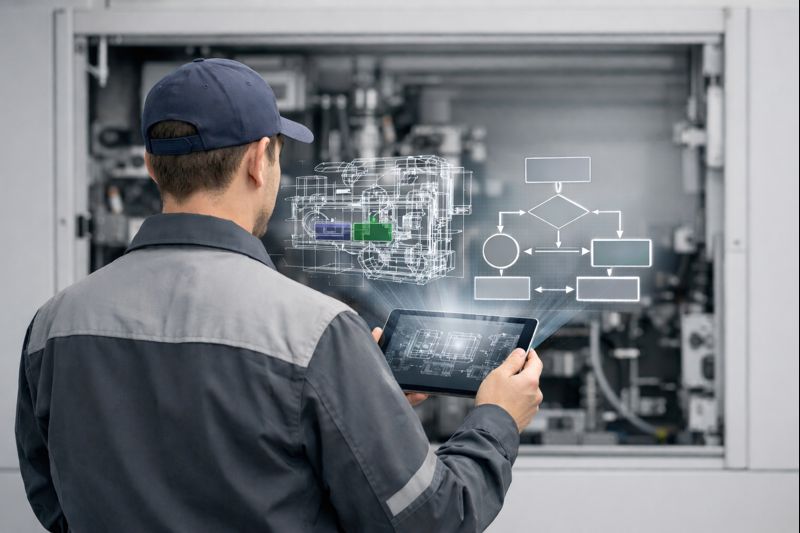
Technology and Service
Technical and service organisations benefit especially when relevant knowledge is available directly at the point of deployment. Vimmera AI provides technical information, setting values, warnings, best practices, and experiential knowledge in context, so that employees can work safely and efficiently even in complex situations. Typical tasks can thus be supported much better. Setting values and parameters can be found quickly and applied correctly, causes of errors are analysed in a targeted way, and repair instructions with variants and dependencies are taken into account. Documentation, protocols, and special case constellations can be categorised and compared. At the same time, proven procedures and safety-relevant instructions are automatically considered, so that quality, safety, and reliability increase in daily operations. A medium-sized industrial company…
Expert opinions and complex documents
For expert opinions and extensive, complex document collections, a clear structure determines whether content actually becomes usable. Vimmera AI helps to unlock, compare, and selectively evaluate large amounts of text without having to manually read hundreds of pages. Content is not only found, but also understood in its context and made usable for decision-making. Typical tasks can thus be handled much more efficiently. Key statements, lines of argument, and conclusions are systematically worked out. Different versions, counter-expert opinions, or statements can be compared, and content deviations, contradictions, or agreements can be made visible. Relevant passages, sources, and evidence can be identified and placed in the correct context. On this basis, comprehensible summaries for non-specialists can be created, and rebuttals, statements,…
Complex calculations
Particular added value arises in complex calculations and analyses when questions can be described in natural language and the results remain understandable, verifiable, and reproducible at the same time. Another area in which Vimmera AI’s AI systems create clear added value is demanding calculations, analyses, and numerical evaluations. While classic tools such as spreadsheets or specialist software are powerful, they often require special expertise, manual input, and a great deal of time. AI-supported systems enable a different approach: tasks can be described in natural language while context, framework conditions, and additional information are taken into account in a structured way. A concrete example of this is a Vimmera assistant for sound calculation for apartment ventilation units as well as for…
Customer service and support
In customer service, Vimmera AI helps employees appear more confident, provide better-informed advice, and at the same time experience noticeable relief. In customer service, Vimmera AI helps employees appear more confident, provide better-informed advice, and at the same time experience noticeable relief. In the past, when faced with more complex questions or special situations, they often had to consult others, conduct lengthy research, or improvise. This took time, created uncertainty, and not infrequently led to varying quality of responses. Today, they have an intelligent assistant at their side that consolidates relevant company knowledge, product information, process descriptions, and case-based experience and makes it available in an understandable form. This enables customers to receive well-founded, consistent, and high-quality answers more quickly…
Sales & Quotation Preparation
Sales clearly benefits when proposal and tender work becomes faster, more consistent, and less dependent on the individual knowledge of specific employees. Vimmera AI helps to structure complex requirements, bring together relevant information, and systematically prepare proposals. Tenders and inquiries can be automatically analysed and converted into clear requirements, criteria, and service modules. Suitable references, product modules, technical descriptions, and previous proposal components are specifically identified from the company's knowledge base. On this basis, proposals can be formulated consistently and technically correct. At the same time, the results can be prepared so that they can be directly transferred into ERP and CRM systems. In addition, risks, deviations from standard services, open points, and queries are made visible. This results in…
Marketing and Communication
Marketing and corporate communications benefit particularly when content is not based on loose knowledge or individual wording, but on a secure and consistent information base. When texts, statements, and messages are derived from verified company information, significantly higher content quality, professional accuracy, and consistency across all channels are achieved. The solutions from Vimmera AI help create and further process content systematically. Draft texts for websites, brochures, newsletters, social media, or internal communications can be generated on the basis of the central knowledge base. Existing content can be specifically adapted to different target groups, communication channels, or formats without core messages being lost or becoming contradictory. At the same time, the system ensures that terminology, tone, corporate language, and professional standards…
Personnel (HR) and Organization
HR and organizational processes, especially in the HR department, benefit when policies, job descriptions, workflows, and internal knowledge are centrally managed, kept up to date, and securely available. Employees and managers can quickly find reliable information, while sensitive HR and company data is processed in a controlled and GDPR-compliant manner. Especially in HR, there are high requirements for confidentiality and legal certainty. That is why solutions are used that control access in a targeted way and do not transfer data to external servers, for example through the local use of LLMs without cloud connection. Vimmera AI supports HR and organization teams in their day-to-day work. New employees receive suitable answers and relevant information quickly during onboarding. Questions about processes or…