Our approach
What makes us and our services special?
Vimmera AI deliberately does not follow the approach of merely providing software that enables companies to quickly “build something” themselves. Our goal is to develop sustainable AI systems together with our customers that are reliable, secure, high-quality, and usable in the long term. For us, AI is not created overnight and not by simply uploading documents, but through a structured, collaborative, and practice-oriented approach.
A central principle here is: a quick solution is rarely a good solution, especially when it comes to AI. In this field in particular, “quick offers” seem especially tempting. A chatbot can be set up in just a few days, documents are uploaded, and initial answers appear. What is impressive in the short term, however, often remains superficial, unreliable, and not professionally sound in practice. Such systems know neither the real processes nor the actual company knowledge; they deliver contradictory or incomplete results and cannot bear responsibility.
These very experiences are a common reason for skepticism toward AI. When initial attempts disappoint, prejudices, uncertainty, and the impression arise that AI cannot be used reliably in the company. In reality, it is not the technology that fails, but the approach. AI must be deliberately, professionally, and controllably built, introduced, and operated, with clear rules, a clean knowledge base, and continuous quality assurance.
That is why everything begins with understanding the organization. Workflows, goals, existing IT structures, security requirements, knowledge sources, and realistic application possibilities are analyzed together. The primary focus is not on technology, but on where AI actually creates added value, what benefits it should deliver, and how employees can be supported in the best possible way.
In this context, we usually conduct what is known as a DEX analysis. DEX stands for Digital Employee Experience, meaning the digital work experience of employees. Together, real work processes, digital obstacles, and the use of existing systems are recorded, for example in email processing, customer contact, or quotation preparation. This results in key figures that enable an objective comparison between the initial situation and the state after the introduction of AI solutions. This makes it visible what concrete benefits the systems provide and where further optimization makes sense.
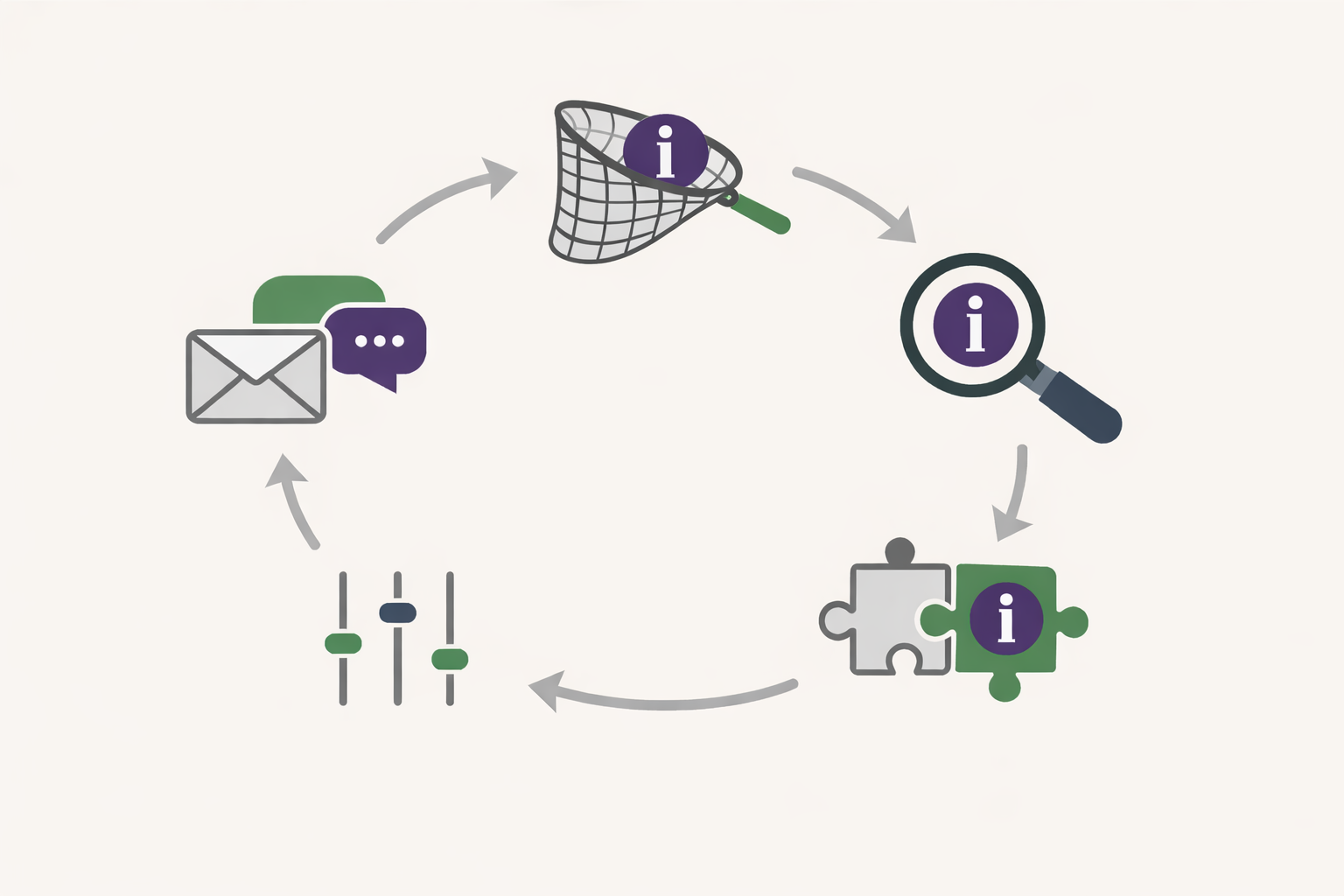
A key next step is the systematic work on company knowledge. This knowledge is usually distributed across many sources, such as documents, guidelines, protocols, ticket systems, training materials, presentations, technical documents, or service reports. A considerable part also lies in the experience of employees. Vimmera AI identifies these knowledge sources together with the customer, brings them together, structures content, resolves contradictions, and supplements missing information, for example through interviews with subject-matter experts. This creates a robust, complete, and quality-assured knowledge base that can be used by AI systems in a controlled and meaningful way.
On this basis, the AI solutions are developed, integrated into everyday work, and connected to the existing system landscape. Care is taken to ensure that the applications are practical, intuitive, and suitable for everyday use, and that they fit seamlessly into existing work environments.
Another essential component is quality assurance. Systems and results are tested, reviewed, and continuously developed further together with customers. Customers receive tools to evaluate, supplement, and specifically improve content. In this way, a continuous improvement process is created that ensures the solutions consistently deliver the required quality over time.
Even after implementation, Vimmera AI remains an active partner. Knowledge is kept up to date, systems are further developed, and new requirements are integrated. In this way, no short-term AI projects are created, but rather stable, growing, and future-proof solutions that support companies in the long term.
Training, instruction and support
The use of artificial intelligence is fundamentally changing the world of work. New tools are emerging, new opportunities are opening up, and at the same time questions, uncertainties, and new requirements are arising. For AI to be not only technically implemented in a company but also used effectively and responsibly in everyday work, knowledge, understanding, […]

Introducing AI in the company
The introduction of artificial intelligence begins in many companies with a simple thought:We should use AI. Shortly afterwards, the first very specific questions arise: With each of these questions, it becomes clear that artificial intelligence is not about a single tool, but about a complex interplay of technology, law, organization, and people. The topics quickly […]

Our approach
What makes us and our services special? Vimmera AI deliberately does not follow the approach of merely providing software that enables companies to quickly “build something” themselves. Our goal is to develop sustainable AI systems together with our customers that are reliable, secure, high-quality, and usable in the long term. For us, AI is not […]

Introduction and Change Management
AI only works if people use it: introduction and change ensure acceptance, clear rules, and real adoption in everyday work. The use of AI is not just a technical issue; it always also affects people, their work, their responsibility, and often their feelings. That is why change management is a central component of every collaboration […]
Support and further development
After the start comes the benefit: support ensures that quality, acceptance, and impact continue to increase permanently instead of stagnating. With the introduction of an AI system, the work is not finished; it really begins there. Vimmera AI does not leave companies alone after go-live, but sees the collaboration as a long-term partnership. Our solutions […]