Insight #2
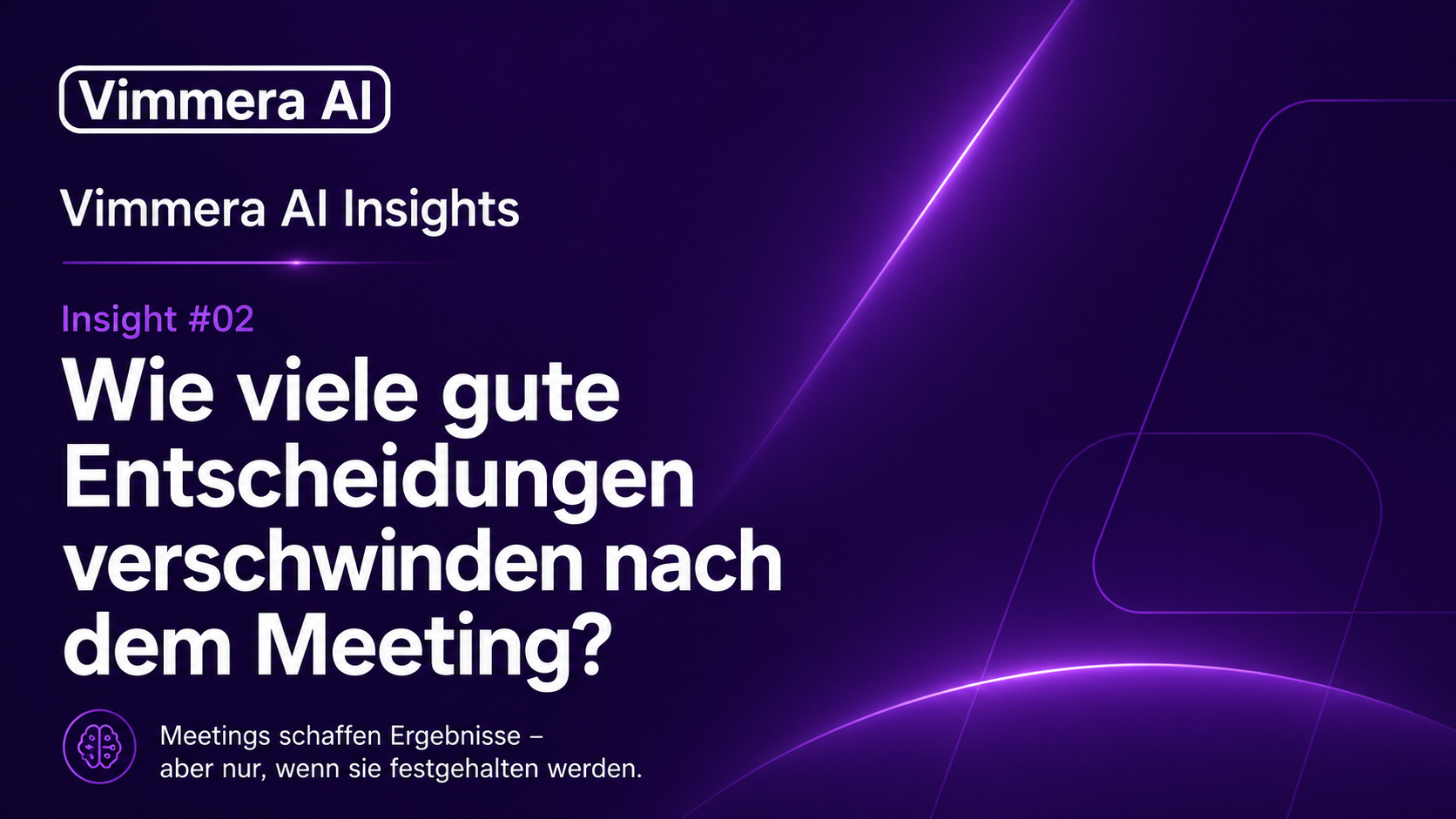
How many good decisions disappear after the meeting?
“We had already decided that.”
A sentence that comes up regularly in many companies. And almost always the same questions follow.
- Where is that documented?
- Who should take on the task?
- Was that already decided or just discussed?
- Is there a record of it?
- Or do we simply remember it differently?
And yet the meeting was actually successful. At least in that moment.
A meeting generates far more knowledge than a protocol can capture
Meetings are far more than appointments in the calendar. Ideas emerge here. Decisions are made. Risks are assessed. Responsibilities are assigned. New solutions are developed.
But once the meeting ends, often only a summary remains. Sometimes not even that.
However, the real value of a meeting lies not in the conversation itself. But in the knowledge that is created in the process.
Many meeting assistants listen. Modern AI understands context.
The first generation of AI meeting assistants mainly did one thing: transcribed conversations and then summarized them.
That saves time. But it only captures a small part of what actually happens during a meeting.
A modern AI assistant goes much further. It does not simply create a record. It can generate different records for different target groups.
Management needs different information than the development department. The project team needs different information than sales.
Each participant receives an individual summary with the decisions, tasks, and information relevant to their own work.
- Tasks are automatically identified.
- Responsibilities assigned.
- To-do lists created.
- Deadlines recognized.
- Open items documented.
A person does not even have to be mentioned by name.
Modern AI systems identify individual speakers and can assign statements, decisions, or tasks to the right person even if their name is never mentioned during the conversation. Phrases like “I’ll take care of it.” or “Can you handle that?” are enough to correctly identify responsibilities.
In addition, the AI compares the course of the conversation with the agenda or defined discussion objectives.
- Were all planned topics covered?
- Are there any questions still open?
- Are there decisions missing that would be necessary for the further course of the project?
In this way, the AI documents not only what was discussed, but also recognizes what still needs to be clarified.
Knowledge is not just language
Particularly valuable are the pieces of information that are usually lost in traditional minutes.
“Please take a look at this drawing.”
“I have a recording here.”
“On slide 12 you can see the problem.”
“I’ll quickly share my screen.”
During a meeting, presentations are shown. Documents are opened. Notes are added. Sketches are created. Photos are viewed. Files are shared. Tables are explained.
For participants, all of this information naturally belongs to the conversation. However, many systems capture only the spoken word.
An intelligent AI assistant, by contrast, looks at the entire context.
- Presentations.
- PDFs.
- Excel files.
- Photos.
- Images from smartphones.
- Whiteboards.
- Handwritten notes.
- Shared screens.
- Attachments.
All information is analyzed together, linked with one another, and placed in the correct professional context.
Because knowledge is not created by words alone. It is created by everything that is shown, explained, and viewed together during a conversation.
From meeting knowledge to company knowledge
The real added value only emerges after the meeting.
The knowledge gained should not remain in personal notes, individual records, or small project groups. It should become part of the company’s knowledge.
- Decisions.
- Experience.
- Professional insights.
- Best practices.
- Discussions.
- Solutions.
All of this information can be directly transferred into a company’s knowledge base.
As a result, it is not only available to the participants of a meeting. Colleagues from other departments, locations, or future projects can also benefit from it.
A decision from a project meeting can help months later with a similar customer inquiry. A technical explanation from a training session supports new employees during onboarding. An objection from a sales conversation provides valuable input for marketing, product development, or customer service.
Knowledge does not remain local. It becomes usable across the entire company. Anytime. Anywhere.
That is precisely why the intelligent processing of meeting knowledge is an important building block of a holistic AI strategy.
Because a successful AI strategy does not just automate individual processes. It ensures that knowledge is permanently retained, intelligently connected, and available where it is needed.
The possibilities extend far beyond meetings
The same technology is no longer limited to classic meetings.
In training sessions, structured learning materials, summaries, and knowledge documentation are created automatically. In presentations, content is prepared in a comprehensible way and later becomes searchable. In sales conversations, the AI recognizes customer requirements, objections, purchase interest, and agreed next steps.
Workshops, project alignments, interviews, customer presentations, or consulting sessions also benefit from conversations being not only recorded, but fully understood.
In this way, every conversation can become a structured source of knowledge.
Vimmera thought starter
Ask yourself after your next meeting:
- Is the result clearly understandable for everyone involved?
- Are tasks and responsibilities fully documented?
- Were all agenda items really covered?
- Are presentations, documents, images, and other materials also part of the documentation?
- Can colleagues who did not attend understand the result without follow-up questions?
- Is the knowledge created in the meeting later also available to other teams and projects?
If you answer one of these questions with no, the greatest potential for optimization probably does not lie in the meeting itself. But in how the knowledge created there is captured, understood, and made usable across the entire company.
Practical question of the week
How much knowledge is lost in your company because today mainly the spoken word is documented and not the full context of a conversation?
Takeaway
A modern AI meeting assistant does not write minutes. It understands context, identifies responsibilities, processes the full context of a conversation, and makes the knowledge created from it permanently usable across the entire company.
Because the greatest added value of a meeting does not lie in what was said. But in the fact that this knowledge is available tomorrow, next week, and even in a year to the right people exactly when they need it.
Want to try it out?
If you are interested in AI meeting assistants, feel free to send an email to info@vimmera.de to get to know our meeting assistant. We provide free and non-binding trial licenses for you.