Time until AI success
Many companies associate AI with the expectation that relief will occur immediately after implementation and that productivity will noticeably increase. In reality, however, this effect usually does not appear immediately after the launch.
AI is rarely a “switch” that is flipped and reliably saves time from day one. Rather, the benefit arises gradually, as a successful AI implementation always means change.
For AI to be truly effective in the organisation, preparation is needed first. Processes must be understood and clearly defined, knowledge must be collected and structured, and employees must learn how to work with the system in a meaningful way. At the same time, day-to-day business continues. It is precisely this combination that often leads to a higher workload at first, before the relief becomes noticeable.
In addition, AI systems often do not work “perfectly” in the first weeks or months. Companies test, review results, correct errors, and gradually improve quality. This targeted optimization is not a setback, but a necessary part of success. Only through feedback, adjustments, and clear rules does a pilot become a system that functions reliably in day-to-day operations and takes over real process work.
Those who understand this dynamic early and communicate transparently plan more realistically, set appropriate expectations, and reduce frustration among employees. At the same time, the chance increases that the company will consistently go through the implementation phase instead of stopping too early. This is exactly how the point is reached more quickly where AI is not just “there” but actually has an effect: with stable use, measurable benefits, and sustainable productivity increases in day-to-day operations.
Why AI does not provide immediate relief
AI only delivers noticeable real value when it reliably runs in everyday work.
For this, the system must understand the organisation’s knowledge, processes, and the requirements of the respective process. This does not happen overnight. An AI implementation is more like a building process than a switch that is flipped.
Especially at the beginning, the workload often increases because new tasks are added to business-as-usual. This is normal and not a sign that the project is failing.
Phase 1: Preparation and foundations for AI in the organisation
Before AI supports or automates processes, companies must create the necessary foundations. These typically include:
Training and enablement
Employees must learn how to work with the system, how to evaluate results, and how to meaningfully integrate AI into the process. These training sessions are added to day-to-day business.
Knowledge building and structuring
Company knowledge must be collected, organised, and prepared so that AI can reliably use it. This often concerns guidelines, process knowledge, documents, best practices, and internal standards.
Process clarity and documentation
Depending on the starting point, companies must describe or document processes more clearly. AI works much better in everyday life when workflows, responsibilities, and quality criteria are clear.
How long this phase lasts depends heavily on the process. Complexity, data availability, existing documentation, and system landscape play a decisive role.
Phase 2: Pilot phase and AI roll-out in day-to-day operations
After preparation, the roll-out or pilot phase begins.
Employees are also needed here. They provide input, test the system, give feedback, and participate in optimization loops. This phase determines whether AI will reliably support later or whether it will remain a “tool” that no one uses.
During this time, the first reliable insights emerge:
Which tasks does AI handle well? Where does it need additional information? What quality standards apply? Which decisions should AI support, and which not?
Phase 3: First productive use and typical double workload
As soon as companies take the first productive steps, a double workload often arises for employees. The process continues to run manually as usual, while the AI works in parallel. Employees simultaneously check the AI results, document errors, and correct where necessary.
In addition to day-to-day business, monitoring and optimisation of the AI systems are added.
This section often feels exhausting because the benefit is not yet fully visible, but the effort is clearly noticeable.
Typical reactions and why frustration arises
In this phase, statements such as:
- This brings no benefit yet.
- I am faster without the system.
- The AI makes too many mistakes.
These are typical reactions because people immediately experience the effort, but the relief comes later. Without good context, trust can decrease and acceptance can suffer.
This is exactly where leadership, communication, and clear expectation management are needed.
The best comparison: onboarding new team members
A very fitting comparison is the onboarding of new colleagues.
There, too, extra effort arises at first. Experienced employees explain, support, monitor, and correct. The benefit does not come on the first day, but as soon as the new person has understood the process and can work productively on their own.
It is the same with AI systems:
At the beginning, guidance, feedback, and monitoring are needed. With each iteration, quality increases. The system becomes more stable, makes fewer mistakes, works more autonomously, and noticeably relieves teams.
When does the AI benefit begin
As the AI system matures, the monitoring effort decreases. Optimisation loops become shorter, errors occur less frequently, and the AI reliably takes on more tasks. Then the effect that companies actually want to achieve sets in:
- noticeable relief in day-to-day business
- faster processes and higher throughput speed
- better quality and fewer manual errors
- more time for value-adding tasks
It is important:
The implementation phase is effort. Those who make this transparent from the start reduce resistance and increase the chance that the organisation will persevere until the benefit becomes visible.
How Vimmera AI accelerates AI implementation
This is exactly where Vimmera AI supports. We help companies shorten the time to AI success by planning the implementation in a structured way, closely supporting pilot phases, and translating optimisation into measurable progress.
We ensure that employees understand why the initial extra work arises, which phase is currently underway, and how this gradually leads to real relief. This keeps acceptance high, the project does not lose momentum, and AI becomes a productive part of processes more quickly.
What the duration until AI success depends on
How quickly AI has a noticeable effect in the company depends mainly on the respective process:
- Complexity and variety of the process
- Quality, availability, and structure of the data
- Degree of existing process documentation
- Requirements for quality, compliance, and control
- Number of roles and interfaces involved
That is why there is no one-size-fits-all timeframe, but a clear logic:
The more structured the foundations and the more consistent the pilot phase, the sooner the relief begins.
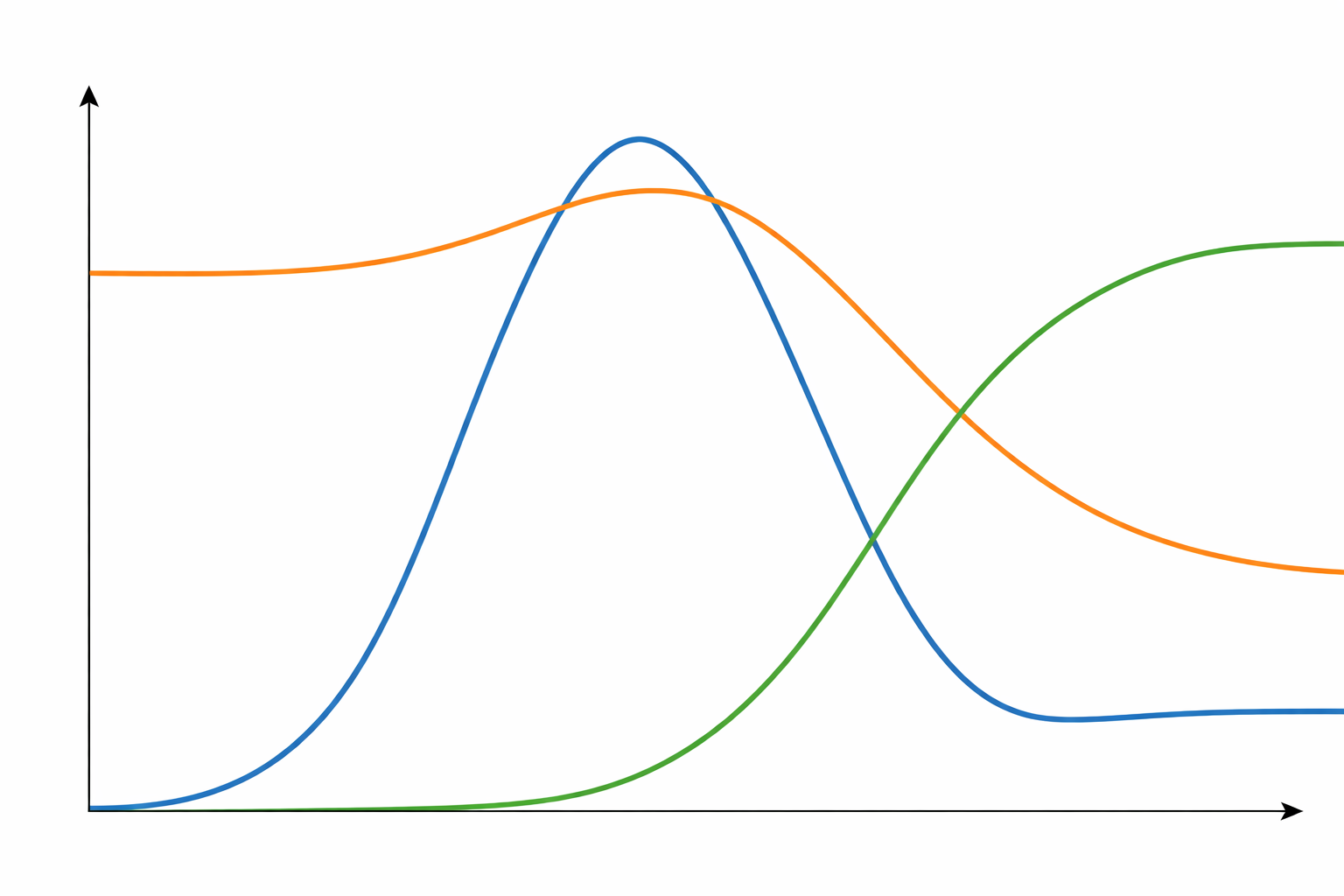
Interactive graphic, click to stop animation:
Statement of the graphic
The graphic illustrates exactly this relationship: At the beginning, companies invest time and energy in implementation, training, knowledge building, and optimisation. The relief sets in with a time lag. As soon as the solution matures, runs stably, and requires less monitoring, the relationship reverses. The effort decreases, the benefit increases, and productivity improves sustainably.