5. Data preparation
Data preparation – from raw material to networked corporate knowledge
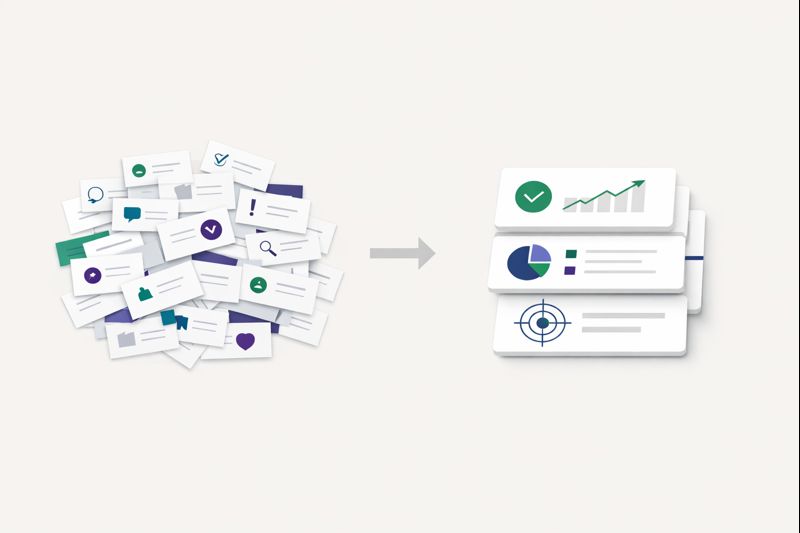
Once the corporate knowledge has been fully collected, the step begins that decisively determines how powerful, reliable, and useful the later AI will actually be: data preparation. In this phase, a large number of individual files, texts, media, system extracts, and experience reports are, for the first time, turned into a coherent, structured, and technically robust knowledge system.
The collected information initially exists in very different qualities. Often, there are several versions of the same content, contradictory statements, outdated statuses, informal working methods, inconsistent terms, or missing links between related topics. Much has grown historically, is not maintained consistently, or is tailored to different target groups and situations.
A particularly important part of data preparation is the standardization and structuring of your company’s language. Technical terms, internal designations, product names, abbreviations, process names, and typical formulations are prepared and linked in such a way that the AI understands and correctly uses the “language” of your organization, your employees, and your customers. Only in this way can queries be correctly interpreted, content clearly assigned, and misunderstandings avoided. Without this linguistic clarification, many questions go unanswered or are answered inaccurately, incorrectly, or incompletely.
If an AI were to work directly on the unorganized raw material, it could find passages of text and content – but it could not reliably decide which information is valid, up-to-date, and technically correct. It becomes even more difficult with complex questions involving multiple areas of knowledge, rules, products, or processes. Without preparation, the AI lacks the necessary clarity to reliably recognize connections, argue without contradictions, or provide complete, robust answers.
Data preparation is therefore the step in which a viable knowledge base is created from unorganized information – a knowledge base that is technically consistent, speaks your company’s language, and creates the prerequisite for AI not only to find, but to understand, evaluate, and provide meaningful support.

From document to knowledge
Another often underestimated aspect is the quality of later answers with large amounts of data. The more information is simply placed in a database and the more data an AI has to consider at the same time, the greater the fuzziness of the hits and outputs. This is a well-known problem of many systems: As the amount of data increases, precision decreases, answers become more general, less accurate, or mix content that has nothing to do with each other technically.
The reason for this is simple: In classic systems, thousands of pages, PDFs, protocols, or manuals are placed side by side. For the AI, these are equivalent text sources. Relevance, validity, responsibility, product reference, or technical context are not clearly represented in them.
Data preparation fundamentally solves this problem by treating information not as documents, but as knowledge. Content is broken down into its technical components: facts, rules, terms, questions, answers, relationships, dependencies, validities, variants, and links. The individual document loses its role as a knowledge container – it is “dissolved.” What remains is the knowledge it contains in a structured, abstract form.
This knowledge is clearly assigned to products, services, processes, functions, categories, or application scenarios. As a result, the total amount of data no longer matters. The AI does not access a large, fuzzy mass of text, but exactly the knowledge modules that are relevant to the respective query.
If desired, the original documents remain available. You can still look up where something is written, specifically find documents, or search for passages of text. However, the crucial point is: The AI does not work with documents – it works with knowledge.
Linking instead of storing
In data preparation, content is not only cleaned up and standardized, but above all linked together. Different sources of knowledge – documents, processes, products, rules, experience values, and system data – are related to each other. This creates a knowledge network in which the AI not only knows individual facts, but also their meaning, validity, and context.
Among other things, it is determined:
- which documents belong to which processes
- which products, article numbers, variants, and rules belong together
- which functions are intended for what – and when they are not useful
- which exceptions, alternatives, or dependencies exist
- which information should be considered together in which situations
Only then can the AI later not only find information, but also classify, combine, and evaluate it correctly.
Technical logic instead of chance
In data preparation, it is also defined which links should be applied automatically in which situations. This creates a technical logic according to which the AI works.
Examples:
- For a price inquiry, the system automatically recognizes the product, the appropriate article number, associated variants, valid discount groups, and relevant conditions.
- For a query about a function, not only is it explained what it does, but also whether it makes sense in this specific situation, what restrictions apply, or which alternatives would be better suited.
- For service inquiries, device, error code, known causes, suitable spare parts, and proven solution steps are automatically linked together.
- For process questions, responsibilities, forms, guidelines, and dependencies are considered simultaneously.
Such answers are only possible if knowledge has been structured, networked, and technically modeled – not if it is merely stored as files.
What you get out of it
Data preparation creates a knowledge base that:
- is consistent and free of contradictions
- remains securely and reproducibly searchable
- can correctly assign content
- recognizes relationships
- can also handle questions that are not explicitly documented
- and delivers technically robust, comprehensible results
This turns a collection of information into a strategic treasure trove of knowledge – the foundation for an AI that truly understands, supports, and works reliably.
In short
Data preparation transforms isolated content into an intelligent knowledge network.
It is the step that enables an AI to work precisely, contextually, and meaningfully with large amounts of data in the first place.

1. The introductory meeting
The introductory meeting – the first step towards effective AI The use of artificial intelligence in companies does not begin with technology, but with understanding.That’s why every collaboration with Vimmera AI starts with a structured introductory meeting. This meeting serves to truly understand your organization, your challenges, and your goals. It is not a sales […]

2. The analysis discussion
The analysis meeting – from understanding to structure After the introductory meeting, the next decisive step follows: the analysis meeting.This is no longer about a first mutual introduction, but about a systematic, joint understanding of your organization. In this meeting, we begin the structured company analysis based on DEX (Digital Experience & Execution) – the […]

3. The DEX analysis
The DEX Analysis – Clarity About Your Organization The DEX Analysis (Digital Experience & Execution) is the foundation of every successful AI implementation with Vimmera AI. It creates an objective, reliable picture of how your organization actually works – not just on paper, but in real everyday life. After the analysis meeting, we can, if […]
4. The knowledge collection
The collection of company knowledge – making everything visible Before AI can use, understand, and reliably provide knowledge, this knowledge must first be fully and correctly captured. That is precisely why the systematic collection of company knowledge is one of the most important steps on the way to an effective AI solution. This is expressly […]
5. Data preparation
Data preparation – from raw material to networked corporate knowledge Once the corporate knowledge has been fully collected, the step begins that decisively determines how powerful, reliable, and useful the later AI will actually be: data preparation. In this phase, a large number of individual files, texts, media, system extracts, and experience reports are, for […]

6. The data verification
Data Verification – Creating Trust in Knowledge and AI After company knowledge has been collected and structured, cleaned, and linked together during data preparation, the step follows that turns information into truly reliable knowledge: data verification. In this phase, it is decided which content may actually be considered valid, binding, and actively usable. Because even […]

7. Data embedding and data vectorization
Embeddings & vector search – enabling AI to find and use knowledge precisely After knowledge has been collected, processed, and verified, the next step ensures that the AI can later access this knowledge quickly, precisely, and in the right context: chunking, embedding, semantic processing, and the creation of vector databases (vector stores). This step is […]

8. The selection of the LLM or LLMs
The selection of LLMs – the right AI brain for your tasks After knowledge has been structured, verified, and technically prepared so that it can be found and used precisely, the next central step follows: the selection of Large Language Models (LLMs). LLMs are the “thinking machines” behind AI – they determine how language is […]

10. Implementation of security mechanisms
Additional security mechanisms – protection for knowledge, systems, and results In addition to selecting and combining the appropriate LLMs, another important step is implemented depending on the requirements and area of application: the implementation of additional security mechanisms. Because your knowledge is valuable, and it deserves the same protection as any other business-critical system. Vimmera […]

9. Prompt Engineering
Prompt Engineering – Giving AI a Clear Identity After the company knowledge has been collected, processed, and verified, another central step follows: prompt engineering. In this phase, it is determined how the AI thinks, responds, and acts. Vimmera AI takes this step in close coordination with you, because this is not about technology, but about […]

11. Additional data sources and interfaces
In addition to the knowledge base from documents and verified company knowledge, it may be useful or necessary—depending on the application—to connect additional data sources. This includes the additional implementation of databases, business systems, and other data interfaces, for example via modern integration standards such as MCP. The background is simple: Not everything an AI […]

12. Customization of the user interface
Frontend & User Interface – AI where people really work For AI to be effective in a company, it is not enough for it to work technically. It must be available where employees actually work – simply, reliably, and without additional hurdles. That is why Vimmera AI generally relies on browser-based frontends. Browser-based solutions offer […]
13. Rollout of the AI systems
Rollout & Introduction – Bringing AI into Everyday Work Step by Step After all technical, content-related, and organizational foundations have been established, the rollout phase begins. In this step, the AI is not simply “activated,” but is introduced into real everyday work in a controlled, guided, and coordinated manner. The goal is for the AI […]

14. Change Management
Change Management – Safely Guiding People Through Change The introduction of AI is not just a technical project, but a profound organizational and cultural change. New systems, new ways of working, and new possibilities trigger uncertainty, questions, or even fears in many people. Vimmera AI knows this – and that is precisely why change management […]

15. Fine-tuning before the actual launch
Joint fine-tuning before go-live – ensuring quality before it counts After AI has been introduced in initial teams or departments, a targeted phase of joint optimization, adjustment, and error correction follows – even before the system goes live company-wide. This phase is crucial to turn a functioning solution into a truly robust, practical AI. Pilot […]

16. Go-live
the productive start of your AI After the successful pilot phase and joint fine-tuning comes the decisive moment: the go-live. In this step, the AI is officially activated for productive use within the entire defined scope. From now on, it is no longer just a pilot project, but a permanent part of your working environment. […]
17. The second DEX analysis
Measure impact, identify potential, develop in a targeted way After the go-live, the phase begins in which it is decided whether AI has not only been “introduced” but has actually become effective. This is exactly why the DEX analysis is carried out a second time. It is not a formal conclusion, but a deliberately set […]

18. Care, support & further development
so that your AI remains valuable in the long term With the go-live and the second DEX analysis, the AI has successfully arrived in your company. But just like your company itself, your AI does not stand still. Products change, processes are adjusted, new insights emerge, markets and requirements continue to develop. At the same […]

19. Documentation
Transparency, Security and Long-Term Usability A professional AI system is only as good as its traceability. That is why documentation at Vimmera AI is not a by-product, but a central component of every solution. It ensures that your AI system not only works today, but also tomorrow, in a year, and in a changed organizational […]