4. The knowledge collection
The collection of company knowledge – making everything visible
Before AI can use, understand, and reliably provide knowledge, this knowledge must first be fully and correctly captured. That is precisely why the systematic collection of company knowledge is one of the most important steps on the way to an effective AI solution.
This is expressly not about simply uploading documents to a database or a “KI folder.” Such storage creates files – but not yet usable knowledge. Documents contain content, but usually very little of the context that is crucial for professional use: In which process does this information apply? For which role? Is it current? What exceptions exist? What experiences have employees had with it?
An AI that only accesses uploaded files can find passages of text – but it cannot really understand what this content means in practice, when it applies, and how it must be used. An effective AI does not work like a document search, but like a knowledge-based assistant. It must be able to recognize relationships, classify content, understand dependencies, and place knowledge in a professional and organizational context.
In almost every organization, crucial knowledge is located in many different places: in documents, emails, systems, presentations, training materials, tickets, protocols, videos, audio files, drawings – and last but not least in the minds of experienced employees. A large part of this knowledge is not digital, not centrally available, or not in a form that could be usefully utilized by an AI.
This is exactly where this step comes in. It ensures that not only files are collected, but that the entire knowledge base of your company – in all its formats and sources – is captured and made accessible to AI in the first place. Only on this basis can an AI later be created that not only searches, but understands, supports, and works reliably.
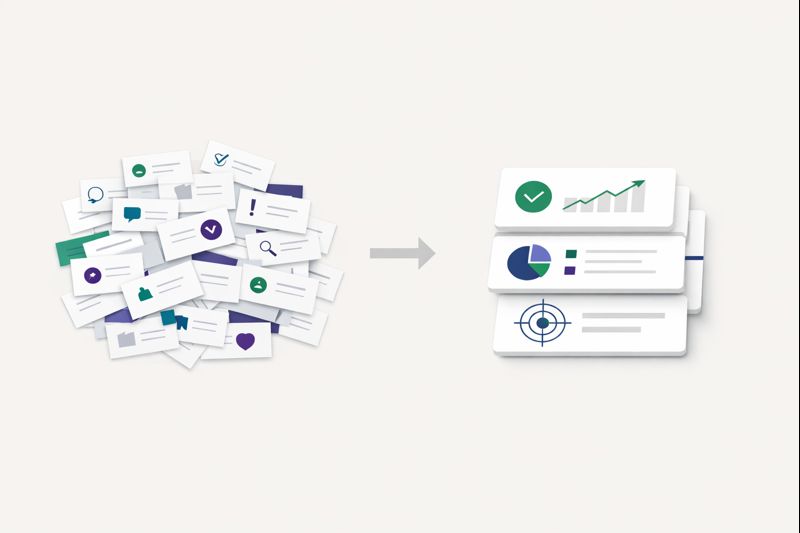
What happens in this step?
In this phase, the focus is deliberately not yet on structuring or evaluating, but on the complete capture and securing of all relevant knowledge sources.
Among other things, we collect:
- Documents, files, and data from existing systems
- Emails, protocols, manuals, presentations, and training materials
- Audio and video recordings from meetings, training sessions, or interviews
- Conversations with employees that are recorded and then transcribed
- Images, scans, technical drawings, or handwritten notes
- analog documents that are digitized
Modern methods such as speech recognition, transcription, text recognition (OCR), and media analysis are used. This also captures information that was previously not machine-usable – for example, from videos, audio recordings, PDFs, photos, or paper documents.
The goal is to make all relevant knowledge available in digital form, regardless of the format or location in which it was previously stored.
Why this step is so important
AI can only work with what is available. Missing, scattered, or non-digitized information inevitably leads to gaps, uncertainties, and incorrect answers. The complete collection of knowledge ensures that nothing important is lost and that the later AI can build on the entire knowledge reality of your company – not just a fraction of it.
At the same time, valuable experiential knowledge is secured: knowledge that previously only existed in people’s heads is preserved, even if employees change companies or retire.
What you get out of it
The systematic collection of your company knowledge ensures that your AI does not have to work with gaps, assumptions, or coincidences, but can build on the complete knowledge base of your organization. This gives you the certainty that no important information is overlooked – neither from documents, systems, and media nor from the experiential knowledge of your employees.
For your company, this means that knowledge is truly secured for the first time. Critical know-how is preserved, even if people change or leave. Information that was previously scattered, hidden, or difficult to find is now available centrally and digitally. This reduces dependencies, accelerates onboarding, and prevents knowledge loss.
At the same time, transparency is created. For the first time, you see what knowledge actually exists, where it is located, and in what form it is available. This makes gaps, redundancies, and unused potential visible – long before an AI even accesses it.
Above all, you create the prerequisite for AI to later not only search individual documents, but to use the entire knowledge space of your company. The quality of the later AI answers depends directly on how complete and clean this foundation is.
In short
In this step, we make all your company knowledge visible, digital, and usable – as the basis for everything that follows.
Only when the knowledge is fully available can it be meaningfully structured, checked, and reliably used by AI. But one essential step is still missing: the preparation of the data.

1. The introductory meeting
The introductory meeting – the first step towards effective AI The use of artificial intelligence in companies does not begin with technology, but with understanding.That’s why every collaboration with Vimmera AI starts with a structured introductory meeting. This meeting serves to truly understand your organization, your challenges, and your goals. It is not a sales […]

2. The analysis discussion
The analysis meeting – from understanding to structure After the introductory meeting, the next decisive step follows: the analysis meeting.This is no longer about a first mutual introduction, but about a systematic, joint understanding of your organization. In this meeting, we begin the structured company analysis based on DEX (Digital Experience & Execution) – the […]

3. The DEX analysis
The DEX Analysis – Clarity About Your Organization The DEX Analysis (Digital Experience & Execution) is the foundation of every successful AI implementation with Vimmera AI. It creates an objective, reliable picture of how your organization actually works – not just on paper, but in real everyday life. After the analysis meeting, we can, if […]
4. The knowledge collection
The collection of company knowledge – making everything visible Before AI can use, understand, and reliably provide knowledge, this knowledge must first be fully and correctly captured. That is precisely why the systematic collection of company knowledge is one of the most important steps on the way to an effective AI solution. This is expressly […]

5. Data preparation
Data preparation – from raw material to networked corporate knowledge Once the corporate knowledge has been fully collected, the step begins that decisively determines how powerful, reliable, and useful the later AI will actually be: data preparation. In this phase, a large number of individual files, texts, media, system extracts, and experience reports are, for […]

6. The data verification
Data Verification – Creating Trust in Knowledge and AI After company knowledge has been collected and structured, cleaned, and linked together during data preparation, the step follows that turns information into truly reliable knowledge: data verification. In this phase, it is decided which content may actually be considered valid, binding, and actively usable. Because even […]

7. Data embedding and data vectorization
Embeddings & vector search – enabling AI to find and use knowledge precisely After knowledge has been collected, processed, and verified, the next step ensures that the AI can later access this knowledge quickly, precisely, and in the right context: chunking, embedding, semantic processing, and the creation of vector databases (vector stores). This step is […]

8. The selection of the LLM or LLMs
The selection of LLMs – the right AI brain for your tasks After knowledge has been structured, verified, and technically prepared so that it can be found and used precisely, the next central step follows: the selection of Large Language Models (LLMs). LLMs are the “thinking machines” behind AI – they determine how language is […]

10. Implementation of security mechanisms
Additional security mechanisms – protection for knowledge, systems, and results In addition to selecting and combining the appropriate LLMs, another important step is implemented depending on the requirements and area of application: the implementation of additional security mechanisms. Because your knowledge is valuable, and it deserves the same protection as any other business-critical system. Vimmera […]

9. Prompt Engineering
Prompt Engineering – Giving AI a Clear Identity After the company knowledge has been collected, processed, and verified, another central step follows: prompt engineering. In this phase, it is determined how the AI thinks, responds, and acts. Vimmera AI takes this step in close coordination with you, because this is not about technology, but about […]
11. Additional data sources and interfaces
In addition to the knowledge base from documents and verified company knowledge, it may be useful or necessary—depending on the application—to connect additional data sources. This includes the additional implementation of databases, business systems, and other data interfaces, for example via modern integration standards such as MCP. The background is simple: Not everything an AI […]

12. Customization of the user interface
Frontend & User Interface – AI where people really work For AI to be effective in a company, it is not enough for it to work technically. It must be available where employees actually work – simply, reliably, and without additional hurdles. That is why Vimmera AI generally relies on browser-based frontends. Browser-based solutions offer […]
13. Rollout of the AI systems
Rollout & Introduction – Bringing AI into Everyday Work Step by Step After all technical, content-related, and organizational foundations have been established, the rollout phase begins. In this step, the AI is not simply “activated,” but is introduced into real everyday work in a controlled, guided, and coordinated manner. The goal is for the AI […]

14. Change Management
Change Management – Safely Guiding People Through Change The introduction of AI is not just a technical project, but a profound organizational and cultural change. New systems, new ways of working, and new possibilities trigger uncertainty, questions, or even fears in many people. Vimmera AI knows this – and that is precisely why change management […]

15. Fine-tuning before the actual launch
Joint fine-tuning before go-live – ensuring quality before it counts After AI has been introduced in initial teams or departments, a targeted phase of joint optimization, adjustment, and error correction follows – even before the system goes live company-wide. This phase is crucial to turn a functioning solution into a truly robust, practical AI. Pilot […]

16. Go-live
the productive start of your AI After the successful pilot phase and joint fine-tuning comes the decisive moment: the go-live. In this step, the AI is officially activated for productive use within the entire defined scope. From now on, it is no longer just a pilot project, but a permanent part of your working environment. […]
17. The second DEX analysis
Measure impact, identify potential, develop in a targeted way After the go-live, the phase begins in which it is decided whether AI has not only been “introduced” but has actually become effective. This is exactly why the DEX analysis is carried out a second time. It is not a formal conclusion, but a deliberately set […]

18. Care, support & further development
so that your AI remains valuable in the long term With the go-live and the second DEX analysis, the AI has successfully arrived in your company. But just like your company itself, your AI does not stand still. Products change, processes are adjusted, new insights emerge, markets and requirements continue to develop. At the same […]

19. Documentation
Transparency, Security and Long-Term Usability A professional AI system is only as good as its traceability. That is why documentation at Vimmera AI is not a by-product, but a central component of every solution. It ensures that your AI system not only works today, but also tomorrow, in a year, and in a changed organizational […]